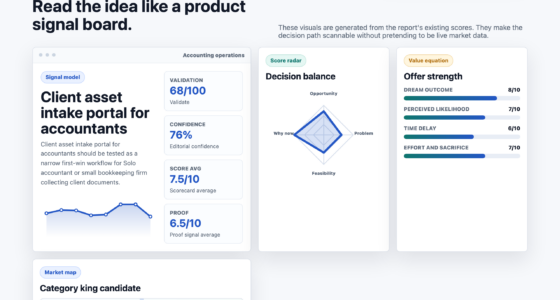
📊 Full opportunity report: When Should Accounting Teams Flag AI-Coded Bookkeeping? on IdeaNavigator AI — validation score, market gap, and execution plan.

Get smart everyday buys delivered free with Prime
- Fast, free delivery on millions of items
- Prime Video, Amazon Music and more included
- Member-only deals all year
TL;DR

A proposal from IdeaNavigator AI recommends testing a risk-flag review layer for bookkeeping firms that use AI transaction categorization. The suggested tool would prioritize suspicious entries rather than require staff to recheck every transaction, but its accuracy and ability to save time have not yet been established.
IdeaNavigator AI has proposed a risk-flag review workflow for bookkeeping and client accounting services firms using AI transaction categorization, aiming to direct staff toward entries that may be miscoded instead of requiring a second look at every transaction. The idea remains a product concept: the IdeaNavigator AI proposal provides no test results, product launch, or verified accuracy figures.
According to the IdeaNavigator AI proposal, the tool would connect to QuickBooks or Xero and score incoming transactions for signals such as an unusual vendor-category pairing, a mismatch between an amount and its supporting document, or spending that appears personal to an owner. It would place transactions judged suspicious into a review queue with the related source document and a plain-language explanation of the flag.
The proposal suggests that a minimum viable product surface roughly the riskiest 10% of transactions, rather than expose staff to every entry. That figure is a proposed design target, not a measured result. IdeaNavigator AI recommends testing the scorer retroactively on three firms’ most recent quarter of ledgers, comparing confirmed miscoding errors caught with the total number of flags raised.
The proposal describes a strong early signal as catching most known errors while flagging less than 15% of transaction volume. It does not define “most,” provide a current error rate, or report that any firm has completed the test. Pricing is also only a concept in the proposal: monthly charges per client ledger, set against the review hours firms might save.
When Should Teams Flag AI-Coded Bookkeeping?
IdeaNavigator AI proposes a risk-flag review queue for AI-categorized transactions. Its accuracy and time savings have not been established.
What the queue would flag
The proposal would score transactions and send suspicious entries, supporting documents, and plain-language reasons for review.
Unusual vendor coding
A subscription classified as fuel could be sent to the review queue.
Amount does not match
A transaction amount that conflicts with its supporting document could raise a flag.
Possible personal expense
Spending that appears personal to an owner could be reviewed; a flag is not proof of an error.
Targets are not results
The proposal offers rough design and validation targets, with no reported test performance.
- Surface roughly 10% of transactions for review.
- Prioritize suspicious entries instead of rechecking every transaction.
- Catch most known errors.
- Flag less than 15% of transaction volume.
- “Most” is undefined, and no test is reported.
How to test the idea
IdeaNavigator AI proposes a retroactive test using prior-quarter ledgers from three firms.
Apply it to the firms’ previous-quarter ledgers.
Count known miscodings caught and the total flags raised.
Track missed errors and the staff time needed to resolve flags.
What firms still need to know
The proposal leaves key performance and operational questions unanswered.
| Question | Reported status |
|---|---|
| Accuracy and error detection | Not reported |
| False flags and missed errors | Not measured |
| Pricing, costs, and security | Not specified |
| Product availability | No launch reported |
Reviewing Risk Without Rechecking Everything
The IdeaNavigator AI proposal addresses a practical tension for firms adopting AI categorization: automated entries can look tidy while still carrying the wrong accounting label. Its examples include a subscription classified as fuel and an owner draw recorded as an expense. If staff have to inspect every automated entry to catch errors, the review work may reduce the time saved by automation.
A focused queue could, if testing supports it, help teams spend review time on entries with stronger warning signs. That matters because bookkeeping classifications can affect the records clients rely on for reporting and tax preparation. But a flag is not proof of an error, and an unflagged entry is not proof of correctness. Firms would still need clear review procedures and human judgment; the proposal supplies no evidence that the suggested scoring method can reliably separate risky transactions from routine ones.
Products Worth Considering

HP DesignJet T650 Large Format 24‑inch Plotter Printer (5HB08T)

Samsung Odyssey G9 QD-OLED 49 Dual QHD Curved Gaming Monitor

FLEXISPOT Electric Adjustable Workbench, 55 x 28 Inches, White
As an affiliate, we earn on qualifying purchases.
Automation Creates a Review Bottleneck
The IdeaNavigator AI proposal is aimed at partners and operations leads at bookkeeping or client accounting services firms already using AI tools to categorize transactions. Its underlying concern is that automation can speed up initial coding without resolving how firms should check those results efficiently.
IdeaNavigator AI characterizes the opportunity as timely because firms adopted AI categorization widely during 2025–2026, while exposure from miscoded books remained. The proposal does not accompany that characterization with adoption statistics, survey results, or independent evidence. Its suggested next step is a limited historical test, not a claim that a new review standard or commercial product is already in use.
Accuracy and Error Rates Unreported
The IdeaNavigator AI proposal reports no results showing how often AI-coded bookkeeping entries are misclassified, how many errors a risk scorer would detect, or how often it would send correct entries for review. It also does not specify the scoring method, how firms would set thresholds, or whether performance would differ across clients, industries, bookkeeping systems, or transaction types.
It is also unclear how the suggested 10% review target relates to the proposed validation threshold of flagging under 15% of volume. Those are compatible as rough targets, but the proposal does not explain whether the figures apply to the same test, whether the system could flag a larger share when needed, or how missed errors would be measured. The proposal states no pricing, operating costs, security arrangements, or product availability.
Test Against Prior-Quarter Ledgers
IdeaNavigator AI proposes running the scorer on the previous quarter’s ledgers from three accounting firms. The proposed test would compare flags with errors already confirmed through review and count both the known miscodings caught and the total flags raised. That would provide an initial measure of detection and review burden, though it would not by itself establish performance across the broader market.
For firms considering the approach, the practical question is whether the queue catches enough meaningful errors without creating a new volume of low-value checks. A useful assessment would need to track missed errors as well as flagged ones and record the staff time needed to resolve each flag. IdeaNavigator AI has not announced when testing will begin or whether a product will follow.
Source: IdeaNavigator AI
Key Questions
What does the proposed bookkeeping review tool do?
According to IdeaNavigator AI’s proposal, it would score AI-categorized transactions for risk signals and send suspicious entries, along with supporting documents and plain-language reasons, to a review queue.
Is the tool available now?
No launch or availability is reported in the IdeaNavigator AI proposal. The risk-flag workflow is described as a product concept that needs testing.
How would IdeaNavigator AI test the idea?
The proposal calls for running the scorer retroactively on three firms’ prior-quarter ledgers and comparing confirmed errors caught with the number of flags raised.
Does the proposed 10% figure mean the tool is proven to work?
No. Surfacing about 10% of transactions is a proposed design target in the IdeaNavigator AI proposal, not a reported test result. The proposal also names flagging under 15% of volume as a possible validation signal, without providing measured performance.
Source: IdeaNavigator AI