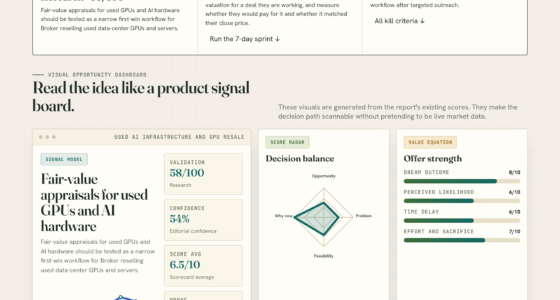
📊 Full opportunity report: Restaurant Invoice Audits For Better Food-Cost Control on IdeaNavigator AI — validation score, market gap, and execution plan.

Get smart everyday buys delivered free with Prime
- Fast, free delivery on millions of items
- Prime Video, Amazon Music and more included
- Member-only deals all year
TL;DR

A proposal for restaurant groups would compare supplier invoices against orders, deliveries and agreed prices to flag billing discrepancies and track credit requests. It recommends testing the workflow against 90 days of paid invoices at three groups; no trial results or recovered-credit figures are provided.
IdeaNavigator AI has proposed a supplier-invoice auditing workflow for independent restaurant groups, designed to compare what locations ordered and received with what suppliers billed and what contracts or quotes specified. The proposal recommends testing the process across three restaurant groups using 90 days of paid invoices; it does not report a launched product, completed test or verified savings.
The proposed tool is aimed at a purchasing director or controller managing an independent group with multiple locations and purchases from broadline and specialty food-and-beverage suppliers. Its intended checks cover prices that differ from contracts or quotes, full charges for short-shipped cases, higher prices for substitutions and increases between successive orders. These are the types of discrepancies the proposal identifies as possible sources of food-cost leakage, not findings from a documented audit.
For an initial product, the proposal calls for importing invoices through electronic data interchange where available, or otherwise extracting details from PDF files and photographs. The system would also use supplier contracts or quote sheets and the restaurant group’s order guide to compare each invoice line with the ordered, received, billed and agreed quantities or prices. It would then flag potential discrepancies, prepare supplier credit requests and track them until a credit appears on a later invoice.
The suggested business model is a monthly subscription per location, with an optional fee tied to recovered credits for customers that prefer that arrangement. The proposal says the idea should proceed only if the test documents credits per location that clearly exceed the planned subscription fee. No subscription price, recovery total or customer commitment is provided.
Invoice audits for better food-cost control
A proposed workflow would compare supplier bills with restaurant orders, deliveries and agreed prices. Its savings potential has not yet been tested.
What the workflow checks
The proposal targets possible billing discrepancies across multi-location restaurant groups.
Compare with contracts
Flag invoice prices that differ from contracts or quotes.
Check billed quantities
Spot full charges for short-shipped cases.
Review price changes
Flag higher-priced substitutions and increases between orders.
How a claim would move
The proposed process connects purchasing records to supplier follow-up.
Import invoices and match them with orders, delivery records and agreed prices.
Identify invoice lines that may not match what was ordered, received or agreed.
Prepare supplier claims and follow them until a credit appears on a later invoice.
The proposed validation
The test is a recommendation; no participating groups or completed results are reported.
- Verify flagged invoice lines
- Record accepted supplier claims
- Confirm credits on later invoices
- Total documented credits per location
- Compare credits with planned subscription cost
- Proceed only if credits clearly exceed the fee
Where Invoice Checks Could Protect Margins
The proposal addresses a gap between purchasing agreements and the bills that are ultimately paid. If an agreed price is not applied, or a restaurant pays for cases it did not receive, the difference can add to operating costs. The proposed review would give finance and purchasing teams a process for identifying and documenting discrepancies across locations.
The proposal cites the USDA Economic Research Service’s September 25, 2026 Food Price Outlook, which forecasts 2026 retail beef and veal prices up 9.4% and wholesale beef prices up 8.5%, while food-away-from-home prices are forecast to rise 3.5%. These are forecasts, not confirmed final price changes, and they do not establish that invoice audits will recover a specific amount. The figures provide market context for the proposal’s focus on comparing supplier bills with agreed terms.
The proposed test would need to assess whether flagged discrepancies are accurate, whether suppliers resolve them and whether resulting credits exceed the cost of the process. A credit request is not itself a recovery, and the proposal provides no evidence about acceptance rates or staff time required.
Products Worth Considering

HP OfficeJet 250 Wireless Mobile All-in-One Inkjet Printer

Apple MacBook Air 13.6-inch with M5 Chip, 16GB Memory, 512GB SSD, Sky Blue

Apple MacBook Air 15-inch with M5 chip, 24GB RAM, 512GB SSD, Midnight
As an affiliate, we earn on qualifying purchases.
The Proposed 90-Day Validation
The proposal frames the auditor as a narrow first workflow for one buyer: the purchasing director or controller at an independent multi-unit restaurant group. It does not describe a general restaurant-management platform. The focus is reconciling supplier invoices against the group’s own purchasing records and agreed prices.
To assess demand, IdeaNavigator AI suggests a retrospective review of 90 days of paid invoices, contracts or quote sheets at three restaurant groups. The proposed assessment would total charges above agreed prices, short-shipped cases billed in full and price increases between orders. Operators would then compare documented credits per location with a planned subscription cost before deciding whether to proceed.
This is a proposed validation method, not a report of completed customer research. No participating groups, audit results, software performance figures or independently checked savings are identified. The USDA figures cited in the proposal supply a market backdrop, but they do not show that a particular restaurant group experienced the listed invoice issues.
Product Results Have Not Been Reported
The proposal does not establish whether the tool has been built, whether restaurant groups have agreed to test it or whether any invoice review has produced supplier credits. It also gives no measured rate of false flags, supplier response times, integration costs or amount of staff review needed to verify discrepancies.
It is also unclear how the system would handle inconsistent invoice formats, disputed substitutions, delivery records that do not capture shortages, or contract terms that vary by location and date. Those details could affect whether the workflow identifies actionable errors and whether suppliers issue credits. The proposed economic test depends on documented credits, but the material does not specify how to count credits that are disputed, delayed or never applied.
Evidence Needed Before Wider Adoption
The next step described is a 90-day retrospective audit at three groups, comparing paid invoices with contracts or quotes and order records. The proposal says to proceed if documented credits per location clearly exceed the planned subscription fee. It gives no timetable for the test or decision and does not report that one is underway.
For an assessment, restaurant operators would need to verify flagged line items, record which claims suppliers accept and confirm when credits appear on later invoices. Results would also need to distinguish credits received from discrepancies identified. Until those details are available, the auditor remains a proposed food-cost-control workflow rather than a demonstrated savings product.
Source: IdeaNavigator AI
Key Questions
What is the proposed restaurant invoice auditor?
It is a proposed workflow that compares supplier invoices with restaurant orders, delivery records and agreed prices to flag possible billing discrepancies and track credit requests.
Has the tool recovered money for restaurants?
No recovery results are reported. The material proposes a 90-day review at three restaurant groups but does not say that the test has been completed.
Which billing issues would it flag?
The proposed checks include prices above contract or quote terms, full charges for short-shipped cases, substitutions billed at higher prices and price increases between orders.
How would the proposal be tested?
It recommends reviewing 90 days of paid invoices alongside supplier agreements or quote sheets for three groups, then comparing documented credits per location with the planned subscription fee.
Source: IdeaNavigator AI