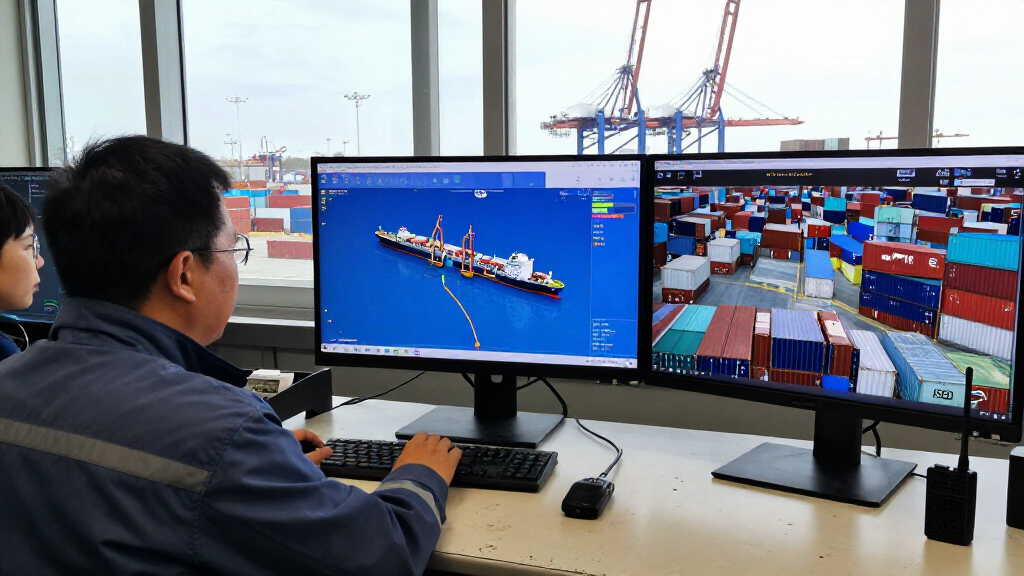

🔍 Read the full analysis: How AI Reshapes Container Port Jobs on ThorstenMeyerAI.com

Get smart everyday buys delivered free with Prime
- Fast, free delivery on millions of items
- Prime Video, Amazon Music and more included
- Member-only deals all year
TL;DR
A November 23, 2026, article from ThorstenMeyerAI.com uses containerization’s history to examine how automation changes port work. It documents major declines in dockworker employment and labor agreements that protected some workers, while citing a 2024 U.S. government report that found automated terminals could have slower moves and more breakdowns. The source does not establish how many jobs AI itself has eliminated or will eliminate.
ThorstenMeyerAI.com published a report on November 23 tracing how containerization transformed port jobs and using that history to frame current concerns about AI and automation. The account documents steep declines in dockworker numbers after cargo moved from individually handled crates to containers, but it does not provide evidence of a separate, measured AI-driven job loss at ports.
Before container shipping, ports relied on break-bulk labor: dockworkers moved sacks, barrels, crates and cartons individually between trucks, warehouses and ships. The source recounts a 1954 shipment aboard the Warrior, bound from Brooklyn to Bremerhaven with 194,582 separate items, each handled and stowed by workers. The process was labor-intensive, slow and costly for shippers.
The report says loose-cargo loading cost about $5.83 per ton in 1956, while Malcom McLean’s accountants calculated a cost of 15.8 cents per ton for the container operation of his ship, the Ideal X. The figures, attributed through historian Marc Levinson’s book The Box, imply a roughly 36-fold difference in loading costs. The source describes the comparison as a calculation, not a measure of job losses or a direct estimate of modern AI’s effects.
Employment figures cited in the article show the scale of the later workforce shift. The Port of New York and New Jersey had more than 35,000 longshoremen in the early 1960s and about 3,500 in 2013, according to the Waterfront Commission. In Britain, registered dockworker numbers fell from a peak of 82,000 to 9,400 in 1989. Those historical totals reflect the broad transformation associated with containerization and other changes; they do not isolate how many positions were eliminated by any single technology.
Infographic 01 · Before the box
Why the port cost more than the ocean
Before the container, every sack and crate was handled one by one. The port, not the sea, was the expensive part of a trip.
One truckload of medicine, Chicago → Nancy (France) · estimate ca. 1960 · total $2,386
Cost of loading one ton · 1956
Roughly 36 times cheaper to load (5.83 ÷ 0.158, our calculation). The loading figures are from Levinson’s own article; other authors cite them to The Box, 1st ed. (2006), p. 52.
Sources: M. Levinson, The Box, 2nd ed. (Princeton UP, 2016), ch. 1, Table 1, p. 12 (American Association of Port Authorities data); M. Levinson, The Box That Shrank the World, Works That Work No. 2.
Powered by Thorsten Meyer AI
How Automation Reshapes Dockwork
The history matters because port automation is not only a question of replacing manual tasks. It also affects who gets work, how predictable jobs are, and who shares productivity gains. The source describes an earlier system in which New York workers assembled daily for a hiring line, known as the shape-up. The Waterfront Commission, established in 1953, said a surplus of labor allowed hiring bosses and corrupt union officials to influence who was selected and who might have to pay a kickback.
Containerization reduced the need to handle every item separately, while shifting work toward operating cranes and coordinating cargo flows. That kind of change can reduce demand for some tasks while creating or changing others; the report does not quantify the balance for AI systems today. The distinction matters for workers, port communities and shipping customers: a technology that lowers handling costs may bring economic benefits, but its employment effects and distribution depend on how it is introduced and what protections are negotiated.
The article also cautions against assuming that automated equipment makes a terminal more productive in every measure. It cites a 2024 U.S. government report that found denser stacking at some automated terminals, alongside slower moves and more breakdowns. That account points to operational trade-offs, rather than a simple claim that automation always increases speed or efficiency.
Products Worth Considering

Dell XPS 13 13.4-Inch Touchscreen Laptop, Intel Core 5 320, 16GB RAM, 512GB SSD

Apple MacBook Pro 13 with Touch Bar, 10th-Gen Quad-Core Intel Core i7 2.3GHz, 32GB RAM, 512GB SSD, Silver (Mid 2020)

Apple Mac mini Desktop Computer with M5 Pro Chip and AppleCare+ (3 Years)
As an affiliate, we earn on qualifying purchases.
From Break-Bulk to the Ideal X
Malcom McLean’s first container voyage described in the source took place on April 26, 1956, when a crane in Newark lifted 58 aluminum truck bodies onto the Ideal X, an adapted tanker. The ship reached Houston five days later, where trucks carried the units onward. McLean did not invent cargo containers, the report notes, but helped establish a system in which a sealed box could move between truck and ship without being unpacked.
On the U.S. West Coast, the International Longshoremen’s and Warehousemen’s Union and the Pacific Maritime Association reached a 1960 Mechanization and Modernization Agreement. As described in the source, employers gained room to mechanize and alter work rules. In return, employers funded protections for registered dockworkers, including income guarantees when mechanization reduced hours, early retirement options and retirement benefits. The deal included a no-layoff promise for covered workers, though the source says the guarantees applied to fully registered “Class A” workers.
The labor dispute did not end with that agreement. The source records a 134-day West Coast strike in 1971 and says East and Gulf Coast dockworkers struck in 2024 over wages and automation. It gives no further detail on the 2024 action or its outcome, so those points should not be treated as a complete account of the negotiations.
““epochal in the annals of industrial relations””
— U.S. Bureau of Labor Statistics, describing the 1960 labor agreement
What AI’s Job Impact Shows
The source offers a historical account of containerization and a brief discussion of modern terminal automation, but it does not report a verified count of jobs lost specifically to AI, identify particular AI systems deployed at ports, or compare employment before and after their introduction. It also does not define whether “AI” means software for scheduling and forecasting, autonomous vehicles, robotic cargo handling or other technologies.
The employment figures span different places and years and cannot establish a single cause for the declines. The 2024 government report is summarized without its title, methodology, terminal sample or detailed results in the supplied material. The source also gives no outcome or full terms for the East and Gulf Coast labor action it mentions. The extent to which current automation changes hiring, wages, safety or work assignments remains unresolved in this account.
Labor Talks and Terminal Results
The next useful evidence will come from more detailed reporting on current labor agreements and terminal performance: which technologies ports are deploying, how many jobs or tasks they affect, and what training or income protections workers receive. The supplied source does not announce a new agreement, a planned port rollout or a forthcoming study, so no specific milestone can be confirmed.
For now, the historical record offers a guide to the questions rather than a forecast. Readers should distinguish the documented effects of containerization from claims about AI, and look for data that identifies the technology, the period measured, the workforce covered and the comparison baseline. Whether new systems reduce headcount, change job duties or improve terminal output will depend on evidence from particular ports and the terms negotiated by employers and workers.
Key Questions
What is the report’s main news?
ThorstenMeyerAI.com published a historical report on November 23, 2026, examining how containerization changed dockworker employment and how that history informs debate over port automation and AI. It does not announce a new AI deployment or a measured AI-related jobs figure.
How did containerization change port labor?
It replaced much of the work of moving individual sacks, barrels and crates with handling standardized containers using cranes and related equipment. The source cites substantial historical declines in registered or employed dockworkers, but those figures do not isolate the effect of one technology.
Did the report find that AI has eliminated port jobs?
No. The source does not provide a verified count of jobs lost specifically because of AI or identify particular AI systems and their employment effects. Its central employment history concerns containerization and mechanization.
Did automated terminals perform better in the cited government report?
The source says a 2024 U.S. government report found denser stacking at some automated terminals, but also slower moves and more breakdowns. It provides no further detail about the report’s methods or terminal sample.
What protections did dockworkers negotiate?
The source describes a 1960 West Coast agreement that allowed employers to mechanize while providing covered, fully registered workers with measures including income guarantees when hours fell, early retirement options and retirement benefits. The guarantees did not apply to every worker, according to the account.
Source: ThorstenMeyerAI.com