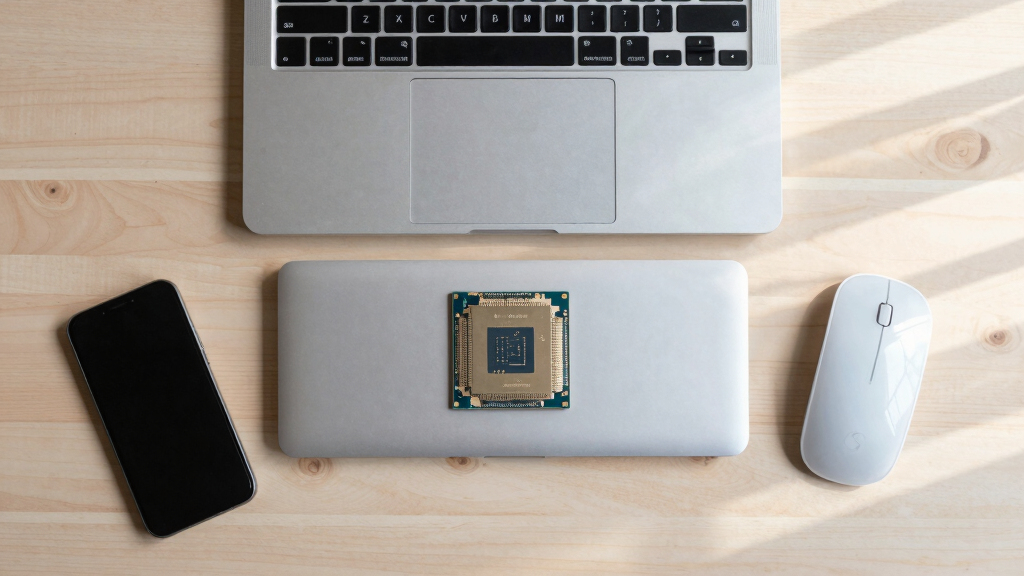

📊 Full opportunity report: Apple Silicon’s Quiet Memory Advantage on ThorstenMeyerAI.com — validation score, market gap, and execution plan.

Get smart everyday buys delivered free with Prime
- Fast, free delivery on millions of items
- Prime Video, Amazon Music and more included
- Member-only deals all year
TL;DR
Apple Silicon’s shared memory design provides a unique capacity advantage for running large AI models locally, surpassing discrete GPU limitations. However, it sacrifices raw speed and is affected by industry-wide memory shortages.
Apple Silicon’s unified memory architecture allows Macs to use their entire RAM pool for large AI models, providing a capacity advantage over traditional discrete GPUs, which are limited by VRAM. This development is significant because it enables consumer-level hardware to handle models previously requiring expensive multi-GPU setups, despite slower inference speeds.
In 2026, Apple Silicon chips such as the M5 Max and M4 Max feature a shared memory architecture where the CPU and GPU access a single, unified pool of physical memory. This design allows Macs with 64GB or more RAM to run models exceeding 70 billion parameters, a feat that typically requires multi-thousand-dollar GPU rigs. This capacity advantage is especially relevant as industry-wide RAM shortages have led Apple to withdraw certain high-capacity configurations, like the 512GB Mac Studio, and raise prices across its lineup.
While this architecture offers unmatched capacity, it comes with a trade-off: slower inference speeds compared to NVIDIA GPUs, due to lower memory bandwidth. For example, an RTX 4090 delivers over 1,000 GB/s bandwidth, whereas Apple Silicon ranges from 546 to 800 GB/s, resulting in fewer tokens per second. Nonetheless, for large models used in personal AI applications, this slower speed can be acceptable given the capacity benefits.
Apple Silicon’s quiet memory advantage
While the discrete-GPU world fought over 24GB of brutally expensive VRAM, a Mac quietly offered to run the big model on one silent, low-watt box. Not magic — but the rare place an architecture beats the squeeze.
Mac Studio 256GB holds a 70B at near-lossless Q8, or 200B+ at Q4 — no single GPU reaches that at any price. Win zone: 32–200B models at 10–30 tok/s for personal/dev use.
M5 Max ~614 GB/s vs RTX 4090’s 1,008. A 70B runs ~12–18 tok/s on M5 Max vs 40–50 on a 5090. You buy capacity, not raw throughput. Bandwidth & capacity matter — not FLOPs.
Apple turned a laptop-efficiency design — one shared memory pool — into the most elegant answer to the part of the squeeze that hurts most: capacity. Bonus: 25–90W vs a GPU rig’s 600–1,200, ~$35–55/yr to run 24/7 vs $300–400, and silent. Right for large models, privacy, low-power always-on; wrong for max speed on small models or heavy training. Next: Build, Rent, or Quantize.
Implications of Apple Silicon’s Memory Strategy for AI Users
This development shifts the landscape of local AI processing by making large models accessible on consumer hardware, reducing dependence on multi-GPU setups. It offers a cost-effective, silent, and power-efficient alternative for users needing substantial memory capacity, especially as industry-wide RAM shortages persist. However, it also underscores that Apple Silicon is not suited for speed-critical applications requiring maximum tokens per second.
As an affiliate, we earn on qualifying purchases.
2026 Industry-Wide Memory Shortage and Apple’s Response
In 2026, the global industry faces a severe RAM shortage, leading to increased prices and reduced availability of high-capacity modules. Apple, which traditionally relies on long-term wafer contracts, has been affected, withdrawing certain high-capacity configurations and raising prices. Despite its architectural advantages, Apple’s unified memory design cannot fully escape the broader industry constraints, highlighting the ongoing supply chain challenges.
Historically, discrete GPUs like the NVIDIA RTX 4090 have dominated large AI model inference, constrained by VRAM limits. Apple’s approach, using shared memory, offers an alternative that prioritizes capacity over raw speed, a shift driven partly by market shortages and cost considerations.
“Our architecture allows users to handle larger AI models efficiently, with a focus on capacity and power efficiency.”
— Apple spokesperson
As an affiliate, we earn on qualifying purchases.
Limitations and Industry Challenges Facing Apple Silicon
It is not yet clear how Apple’s unified memory architecture will perform in real-world, large-scale AI workloads over time, or how future industry shortages might impact supply and pricing further.As an affiliate, we earn on qualifying purchases.
Upcoming Developments and Market Adoption of Unified Memory
Further testing and real-world deployment of Apple Silicon for AI workloads will clarify its performance limits. Additionally, industry supply chain developments and Apple’s future product updates will determine whether this memory advantage sustains or faces new challenges in the evolving AI landscape.
As an affiliate, we earn on qualifying purchases.
Key Questions
Can Apple Silicon handle the largest AI models currently used?
Yes, Macs with sufficient RAM can run models exceeding 70 billion parameters, which are typically out of reach for consumer-grade GPUs due to VRAM constraints.
How does the speed of Apple Silicon compare to NVIDIA GPUs?
Apple Silicon is generally slower per token because of lower memory bandwidth, but it offers larger capacity, making it suitable for different use cases.
Is this architecture suitable for real-time AI applications?
It depends on speed requirements. For tasks needing maximum tokens per second, NVIDIA GPUs are preferable. Apple Silicon excels in capacity for large models where speed is less critical.
Will Apple be able to upgrade memory in future Macs?
No, Apple Silicon Macs have soldered memory, so users should buy the amount they anticipate needing long-term.
How does industry-wide RAM shortage affect Apple’s strategy?
The shortage has led to product discontinuations and price increases, limiting Apple’s ability to offer high-capacity configurations at lower prices, despite architectural advantages.
Source: ThorstenMeyerAI.com
Fall Picks
fall essentials
As an affiliate, we earn on qualifying purchases.