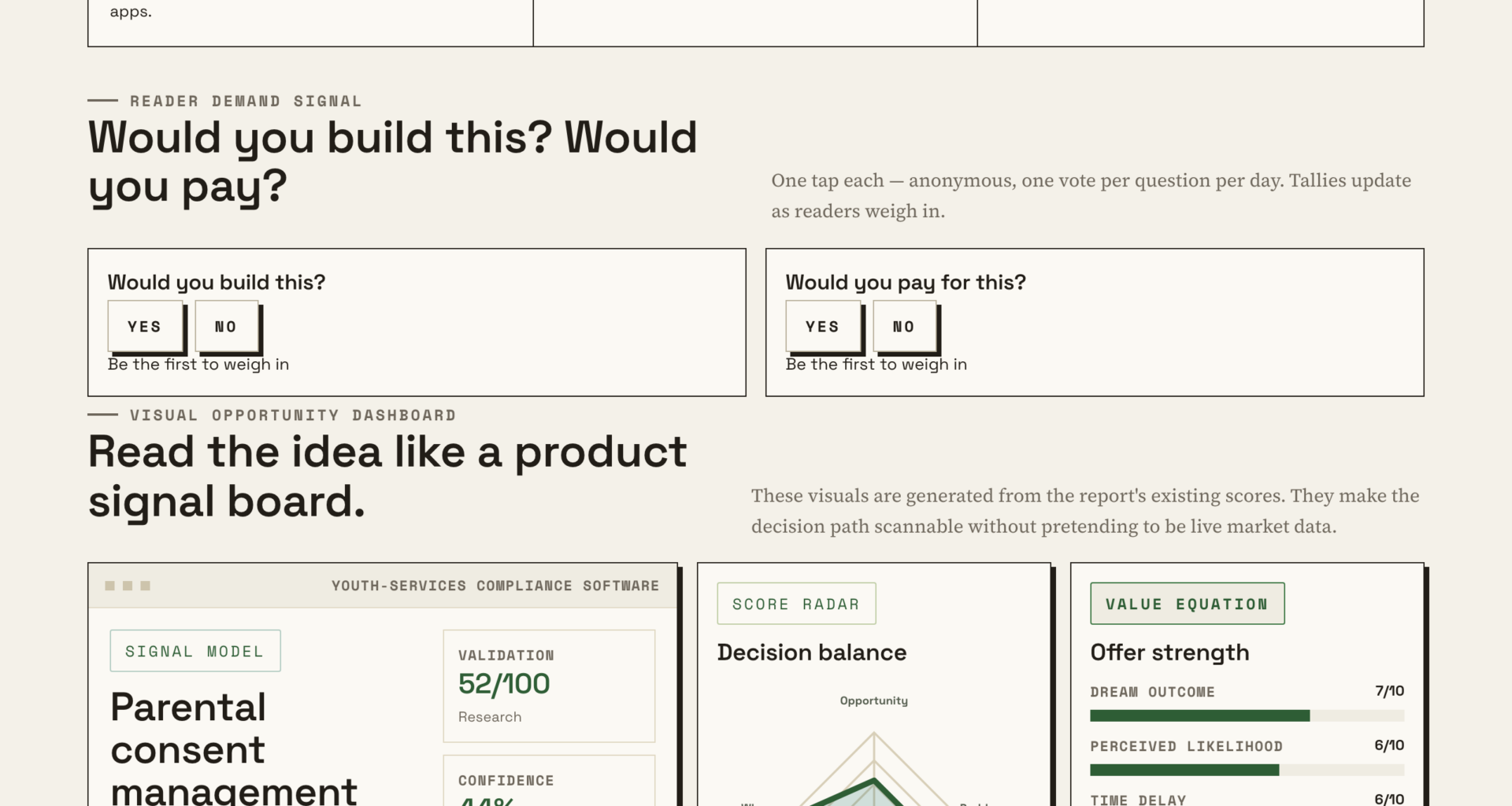

📊 Full opportunity report: Parental Consent Management: Key Considerations For Youth Services on IdeaNavigator AI — validation score, market gap, and execution plan.

Get smart everyday buys delivered free — and shop member deals
- Fast, free delivery on millions of items
- Access to Prime Big Deal Days deals on October 6–7
- Prime Video, Amazon Music and more included
TL;DR
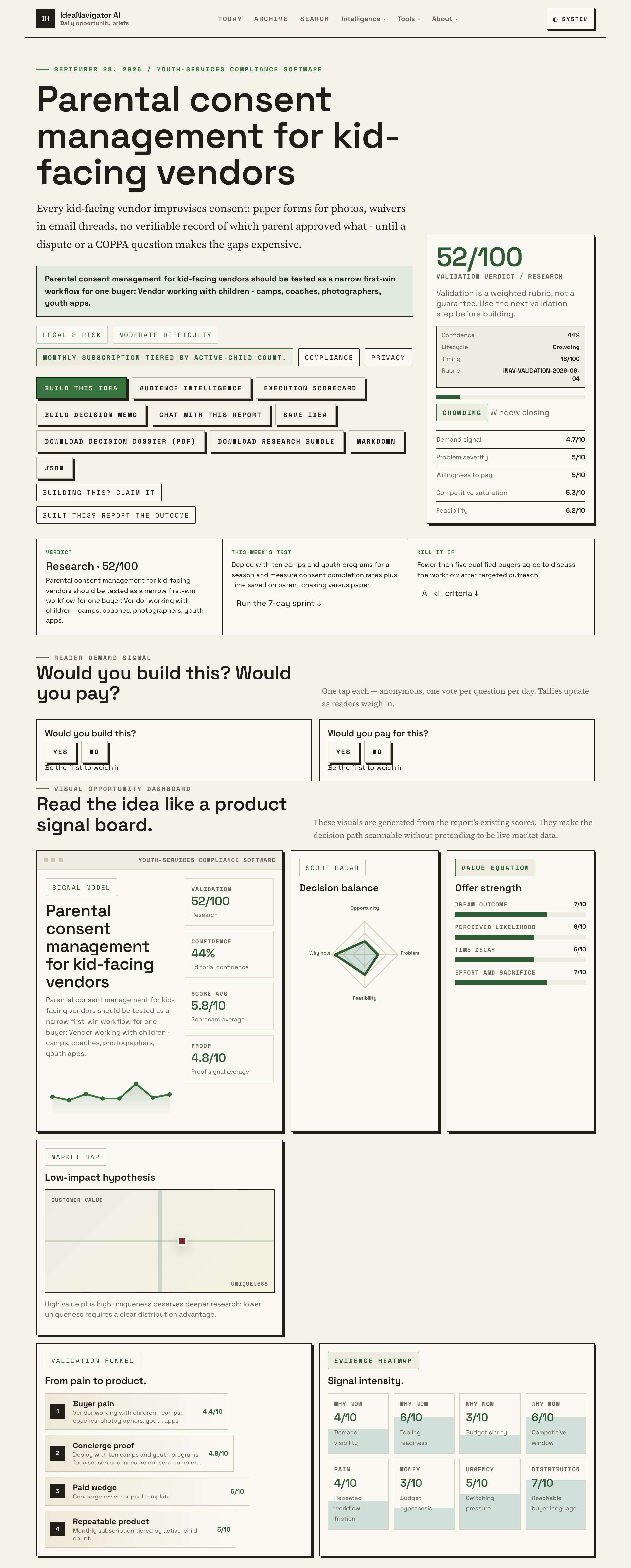
IdeaNavigator AI proposes testing parental consent management software with 10 camps and youth programs over one season. The pilot would assess consent completion and staff time spent following up; no deployment or results are reported.
According to IdeaNavigator AI’s proposal, the service would let vendors send branded forms for parents to complete on their phones. Forms could cover photo use, data collection, medical information and liability. The proposal also calls for identity checks suited to the risk of each consent request, a record for each child, expiry tracking and an option to export records for an audit.
IdeaNavigator AI describes the current problem as a reliance on paper forms and email threads, which can leave organizations without a clear record of which parent approved which use. The proposal identifies camps, coaches, photographers and youth apps as possible customers. These are descriptions of the opportunity and proposed product, not independently reported findings about how widespread the problem is.
To test demand, IdeaNavigator AI suggests deploying the service with 10 camps and youth programs for one season. The proposal names consent completion rates and staff time spent chasing parents, compared with paper processes, as measures. It also suggests a monthly subscription priced by the number of active children. The proposal names no pilot participants, pricing figures or results.
Consent Records for Youth Providers
IdeaNavigator AI’s proposal says an accessible record could help staff see what a parent approved and when that approval expires. That could matter when a provider uses a child’s photograph, collects personal information or needs a medical or liability form on file. The proposal presents these functions as a way to make consent easier to track; it does not establish that the software would meet any particular legal requirement.
The pilot could also show whether a dedicated workflow reduces the administrative work of following up with families. That question matters to smaller providers with limited staff, but IdeaNavigator AI reports no measured time savings or evidence that parents would complete digital forms more often. The proposed season-long test is intended to produce those measures before the product’s value is established.
From Paper Forms to Digital Ledgers
IdeaNavigator AI frames the idea around a practical recordkeeping gap: consent may be collected through separate forms and messages, making it harder for a provider to retrieve a complete history. The proposed ledger would organize approvals by child, purpose and expiry, with an export for review. The proposal does not specify how records would be stored, secured or shared.
IdeaNavigator AI cites expanding children’s privacy enforcement, changes to the Children’s Online Privacy Protection Act (COPPA), state laws and parental challenges to photo and data use as reasons to explore the opportunity. Those points are part of the proposal’s rationale; it provides no specific law, enforcement action, date or case to document a recent regulatory change. The development reported here is the product and pilot proposal itself.
Pilot Scope and Legal Fit
IdeaNavigator AI’s proposal confirms no launch, participating programs or pilot schedule. It also provides no product name, developer, subscription price or technical details for verifying a parent’s identity. The proposal does not define the number of forms to be completed, the comparison method or the threshold for considering the pilot successful.
The proposal does not identify which privacy rules would apply to each type of vendor or how the proposed consent records would address them. It also leaves open how providers would handle separated parents, changes to consent, access requests, data retention and security incidents. Those questions would shape both the product design and its usefulness to organizations.
A Season-Long Test Proposed
IdeaNavigator AI proposes recruiting 10 camps and youth programs for a season-long deployment, then tracking consent completion rates and time spent following up with parents against paper-based processes. The proposal does not say that recruitment has begun or give a start date.
Any eventual results would help clarify whether providers adopt the workflow and whether it reduces administrative effort. Until a pilot is carried out and its methods and findings are shared, the proposal remains an unvalidated opportunity rather than evidence of product performance or compliance.
Source: IdeaNavigator AI proposal
Key Questions
Has parental consent software for youth providers launched?
The IdeaNavigator AI proposal does not report a launch. It outlines a product concept and a possible pilot with 10 programs.
What would the proposed software do?
According to the proposal, it would let parents complete vendor-branded consent forms on phones and give providers per-child records, expiry tracking and audit exports.
How would the idea be tested?
IdeaNavigator AI proposes a season-long test with 10 camps and youth programs, measuring consent completion and staff time spent following up compared with paper processes.
Does the proposal show that the software meets privacy laws?
No. IdeaNavigator AI cites privacy regulation as a reason to explore the idea but provides no legal assessment or evidence that a product meets specific requirements.
Source: IdeaNavigator AI
Evergreen bestsellers Picks
bestsellers
As an affiliate, we earn on qualifying purchases.