
🔍 Read the full analysis: A Closer Look At IBM’s On-Prem AI Strategy on ThorstenMeyerAI.com

Get smart everyday buys delivered free with Prime
- Fast, free delivery on millions of items
- Prime Video, Amazon Music and more included
- Member-only deals all year
TL;DR
IBM CEO Arvind Krishna argued on the company’s Oct. 21 earnings call that open-weight models can deliver about 90% of frontier-model capability at a fraction of the token cost, and said large enterprises could begin with two or three racks. An independent benchmark snapshot shows the leading downloadable model at 80% of the top proprietary model, while hardware economics depend heavily on utilization and the skills needed to operate the systems.
IBM CEO Arvind Krishna told investors on the company’s Oct. 21 earnings call that open-weight AI models can cost a fraction of frontier-model services while delivering about 90% of their performance, making on-premises deployment an option for large enterprises. An independent benchmark snapshot dated Oct. 26 put the leading downloadable model at 80% of the top proprietary model, underscoring that the economics and capability gap depend on the model, workload and operating costs.
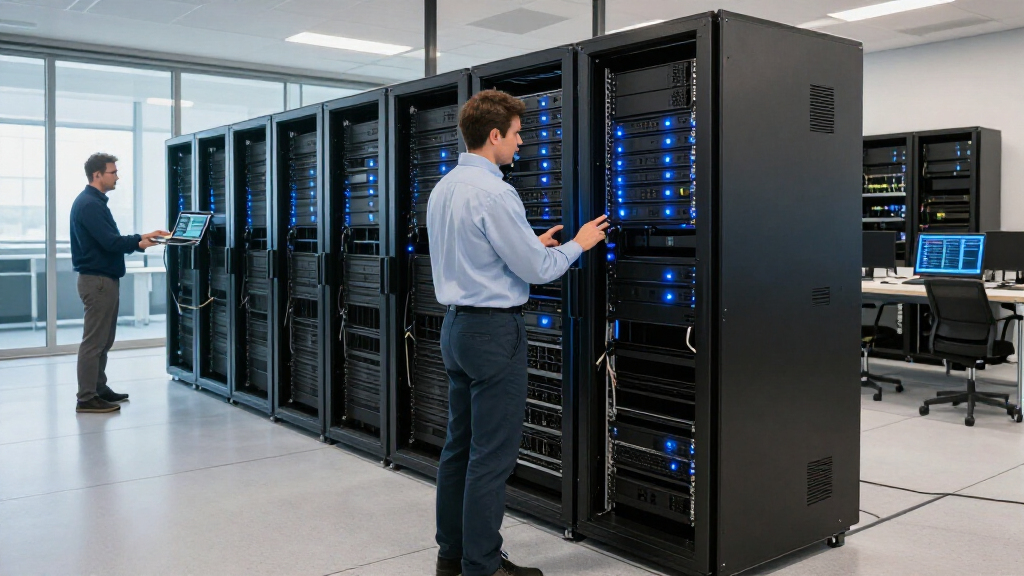
Krishna said open-weight models can cost “25% to 10% of the token cost” of frontier models while being “90% as effective.” He said a large enterprise could start with two or three racks. The comments came during the question-and-answer session, rather than IBM’s prepared remarks. IBM sells infrastructure used in on-premises AI deployments, so its cost and demand claims come from a company with a commercial interest in that approach.
Krishna pointed to routine tasks such as summarizing email, examining contracts and answering customer calls as work that may not require the most capable model. He also said banks and trading firms may want to keep data and logs under their control, describing open-weight models as giving customers the rights to run them on premises or in private clouds. These are Krishna’s arguments for the approach, not evidence that every enterprise workload can be moved without trade-offs.
Artificial Analysis’ index, as read Oct. 26, scored MiMo-V2.6-Pro at 46.3, against 57.6 for proprietary Claude Opus 5.5. That makes the leading model with downloadable weights about 80% of the proprietary leader’s score on that index. Kimi K3.1 Pro scored 55.1, but its weights had not shipped; Moonshot had said they would be available “by Nov 4.” Until release, it remains a closed model for this comparison.
The cost case also varies by how AI is accessed. The source reports that hosted DeepSeek V4.1 Flash 1017, whose weights are MIT-licensed, costs 3% to 6% of Claude Opus 5.5’s listed price. But it also cites closed-model GPT-6 Luna at $0.10 per million input tokens and $0.50 per million output tokens. Those examples show why “open” does not automatically mean the cheapest option for every use case.
IBM's 90% claim, checked
Open weights reach 80% of the leader
Krishna says open-weight models are "90% as effective". On an independent index the best model you can download today reaches 80% of the best closed one, up from about half two years ago.
Best open model as a share of the best closed
Artificial Analysis Intelligence Index, current version, best downloadable vs. best proprietary model at each date.
What Krishna said
Illustrations from the earnings call, not a named benchmark.
- Late 2024"70" vs. "20 or 30"Krishna, Q3 call, 21 Oct · no named benchmark
- Late 2025"70 to 50"Krishna, Q3 call, 21 Oct · no named benchmark
- Now"90% as effective"Krishna, Q3 call, 21 Oct · no named benchmark
Top downloadable models today
Intelligence Index score and licence type. Read the licence before the leaderboard.
| Model | Index | Licence |
|---|---|---|
| MiMo-V2.6-Pro Xiaomi | 46.3 | MIT |
| DeepSeek V4.1 Flash 1017 DeepSeek | 45.1 | MIT |
| GLM-5.3 Z AI | 44.8 | own commercial licence |
| Step 5 Preview StepFun | 43.7 | own commercial licence |
| Muse Spark Open Meta | 38.9 | licence with conditions |
In points the gap did not shrink: 7.5 points at the end of 2024, 11.3 today. Closed models moved too.
Sources: Artificial Analysis, Intelligence Index v4.3.2 (read 26 Oct 2026), IBM Q3 2026 earnings call transcript (21 Oct 2026), Artificial Analysis on Kimi K3.1 Pro (23 Oct 2026).
Powered by Thorsten Meyer AI
The Economics Depend on Utilization
The choice between renting AI capacity and buying hardware is a utilization decision, not just a comparison of token prices. The source puts an eight-GPU H200 server’s list price at $172,643 or more, while renting the same GPU class on AWS costs $63.30 an hour. Using those list figures, the purchase cost equals about 114 days of continuous rental; at 25% utilization, it takes about 15 months of calendar time to reach the same amount, before staffing, cooling and networking costs.
That calculation is a rough comparison, not a full cost-of-ownership analysis. It does not establish that owning the server is cheaper: the outcome depends on utilization, support and facility costs, as well as the cost and performance of the chosen model. A company with steady, high-volume workloads may evaluate ownership differently from one with variable demand or limited in-house expertise.
Krishna acknowledged an operational constraint alongside the savings case. He asked, “Where are my kernel engineers? Where are the people who worry about the underlying network?” He said that skills gap remains outside the most sophisticated enterprises, and described frontier cloud services as more expensive but “the easy answer.” That caveat matters because running models locally involves more than obtaining weights and buying accelerators.
The business stakes extend to IBM itself. Krishna expects on-premises AI demand to support sales of IBM’s Spyre cards. The source also reports that IBM mainframe revenue fell 20% in the quarter, 18 months into the z17 cycle, citing The Register. The available material does not establish a direct link between that result and IBM’s AI strategy, but it helps explain why the company is promoting infrastructure sales as part of its AI offering.
Products Worth Considering

Canon SELPHY CP1500 Wireless Compact Photo Printer with RP-108 Ink and Paper Set

Logitech MX Master 4 for Mac, Ergonomic Bluetooth Mouse with Haptic Feedback, Ultra-Fast Scrolling, USB-C Charging, for MacOS, iPadOS, Windo

Logitech MX Mechanical Full-Size Wireless Mechanical Keyboard, Tactile Quiet Switches, Backlit Keys, Bluetooth, USB-C, Multi-Device, Graphit
As an affiliate, we earn on qualifying purchases.
Benchmark Gains Still Have Limits
Krishna described model performance as having narrowed over time, using a broad benchmark as an illustration: a leading model might score 70 while an open model scored 20 or 30 in late 2024, then 70 versus 50 in late 2025. Those figures were his examples, not results from a named benchmark. Artificial Analysis offers a separate comparison, applying the same ten evaluations across models and identifying whether weights are downloadable.
On that index, the open model’s score was 51% of the proprietary leader at the end of 2024, 74% at the end of 2025, 68% at the end of June 2026 and 80% on Oct. 26, 2026. The relative gap narrowed over that period, although the absolute score difference in the source’s comparison grew from 7.5 points in late 2024 to 11.3 points in October 2026. Proprietary models also improved, so the share-of-leader measure and the point gap tell different parts of the story.
Whether a model is genuinely usable for a business also depends on its licence, not just its score or price. The source identifies MiMo-V2.6-Pro and DeepSeek V4.1 Flash 1017 as MIT-licensed, while other high-scoring models have their own commercial or community terms. IBM also said its llm-d project helps run large models at five to ten times lower cost; that is IBM’s claim, and the source says it could not independently verify the figure.
Costs and Model Access Remain Open
The benchmark comparison is a dated snapshot, and the index score does not establish how a model will perform on a particular company’s tasks. The source does not provide a workload-by-workload comparison of accuracy, latency or total operating cost. Krishna’s 90% figure also does not refer to a named benchmark in the material provided, so it cannot be treated as directly equivalent to the Artificial Analysis result.
Kimi K3.1 Pro’s score would put it close to Claude Opus 5.5 on the index, but the weights had not been released as of the source’s Oct. 26 check. Moonshot had promised availability by Nov. 4; the source says no licence had been published. The model’s stated 2.8-trillion-parameter size also raises deployment questions, but the material does not give a verified hardware configuration or cost for running it.
Hardware estimates are also incomplete. The server-versus-rental figures exclude staff, cooling and networking, and do not account for every possible difference in service, maintenance or financing. The source does not establish whether IBM’s claimed cost reductions from llm-d apply across model sizes and workloads. Nvidia had not commented on the reported GeForce firmware workaround, and its licence prohibits circumventing technical limitations, according to the source; the legal or enforcement outcome is not established.
Track Releases, Licences and Costs
The immediate test for the open-model comparison is whether Moonshot releases Kimi K3.1 Pro’s weights and licence on the promised schedule. If it does, the model can be evaluated as downloadable rather than closed, but its score alone will not settle how practical it is for enterprise deployment. Buyers will also need to review the licence and determine the hardware, staffing and operating costs for their intended workload.
IBM’s on-premises pitch will be tested as customers assess whether they can keep systems sufficiently busy to justify purchasing infrastructure. Useful evidence would include customer deployments, measured performance on business tasks, and comparable total-cost figures that include engineering, facilities and networking. The source provides no such customer-level accounting for IBM’s two-to-three-rack example.
Further checks are also needed for IBM’s llm-d cost claim and the licensing conditions attached to individual open-weight models. For now, Krishna’s remarks set out a strategic case for local AI, while the benchmark and hardware figures show why the choice remains dependent on model access, workload and utilization.
Key Questions
What did IBM’s CEO say about running AI on premises?
Arvind Krishna said open-weight models can cost 10% to 25% of frontier-model token costs while being “90% as effective,” and said a large enterprise could begin with two or three racks. Those are his claims on IBM’s Q3 earnings call, not independently verified cost and performance results.
How close are the leading downloadable models to proprietary AI?
In the Artificial Analysis snapshot dated Oct. 26, 2026, MiMo-V2.6-Pro scored 46.3, compared with 57.6 for Claude Opus 5.5, or about 80% of the proprietary model’s score. The index is one comparison and does not predict performance on every enterprise task.
Does an open-weight model always cost less?
No. Cost depends on the model, provider, workload and whether the company hosts it itself. The source cites low hosted prices for DeepSeek V4.1 Flash 1017, but also a low listed token price for the closed GPT-6 Luna. On-premises operation adds hardware, staffing, cooling and networking costs.
When does buying AI hardware make financial sense?
The source’s comparison suggests utilization is a major factor: an H200 server priced from $172,643 equals about 114 days of continuous rental at $63.30 an hour, or about 15 months at 25% utilization, before other costs. That is a rough break-even comparison, not a complete ownership-cost estimate or a guarantee of savings.
Source: ThorstenMeyerAI.com