
This guide shows you how to choose personal finance books that actually fit your situation, read them with a clear purpose, and — most importantly — turn their advice into action. The task is not simply to “read more about money.” Plenty of people finish a shelf of finance books and change nothing about their finances. You will avoid that trap by working through a repeatable process: define your money goals, select two or three books matched to those goals, read with a note-taking system, and implement one change per book within a week of finishing it.

Get smart everyday buys delivered free with Prime
- Fast, free delivery on millions of items
- Prime Video, Amazon Music and more included
- Member-only deals all year
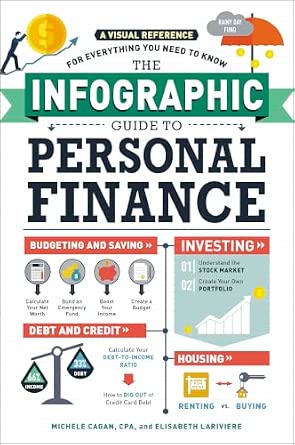
The Infographic Guide to Personal Finance: A Visual Reference for Everything You Need to Know
- ✔ Format: Paperback / ebook
- ✔ Series: Infographic Guide Series
- ✔ Approach: Visual, infographic-based reference

Personal Finance For Dummies
- ✔ Format: Paperback / ebook
- ✔ Series: For Dummies
- ✔ Approach: Comprehensive topical reference

I Will Teach You to Be Rich: No Guilt. No Excuses. Just a 6-Week Program That Works (Second Edition)
- ✔ Format: Paperback / ebook / audiobook
- ✔ Edition: Second edition
- ✔ Approach: Structured 6-week action program
This guide is for beginners and intermediate readers who feel overwhelmed by the volume of finance titles and want a focused, results-oriented approach. No financial background is required. Expect to spend two to four hours setting up your reading plan, then one to three hours per book spread over a few weeks, plus small blocks of time to put each book’s advice into practice.
Difficulty: Beginner | Time: 2-4 hours to set up; several weeks of ongoing reading
What You’ll Need
Tools & Materials:
- A notebook, index cards, or a note-taking app (Obsidian, Notion, Apple Notes, or similar)
- Access to a library, bookstore, or e-book/audiobook platform
- Your recent bank and credit card statements (2-3 months)
- A calendar or reminder app to schedule reading and implementation blocks
Knowledge:
- Basic familiarity with your own income and spending (you will review statements during the setup steps)
- No prior finance knowledge is needed — the book selection step accounts for your starting level
Before buying anything, check your public library. Most libraries offer free e-books and audiobooks through apps like Libby or Hoopla, which lets you preview a book risk-free before committing. Borrowing also lowers the pressure to finish a book that turns out to be a poor fit.
The Infographic Guide to Personal Finance: A Visual Reference for Everything You Need to Know
Not everyone learns money concepts from walls of text, and this is precisely where The Infographic Guide to Personal Finance earns its place in our lineup. By translating budgeting, credit scores, taxes, and investing basics into charts, diagrams, and visual layouts, it removes the intimidation factor that stops many beginners from ever opening a finance book. A concept like compound interest or debt-to-income ratio that takes pages of explanation elsewhere is communicated here in a single spread.Compared with Personal Finance For Dummies, this guide trades depth for clarity. The For Dummies volume explains the reasoning behind financial decisions in far more detail, while the Infographic Guide shows you the shape of the idea quickly. That makes it the better starting point for someone who is completely new to money management — but a weaker choice once you want nuance, since the visual format simply cannot carry extended argument or step-by-step strategy the way a program like I Will Teach You to Be Rich can.We also want to be clear about its ceiling. This is a first book, not a final book. Readers who already understand the basics will find it too elementary, and it works best paired with a more action-oriented title once the fundamentals are in place. Think of it as the on-ramp: it builds vocabulary and confidence fast, then hands you off to something with more machinery.
Pros:
- Visual infographic format makes abstract finance concepts immediately understandable
- Covers a wide range of topics — budgeting, credit, investing, taxes — in a single compact reference
- Extremely low barrier to entry for readers with zero finance background
- Fast to browse and revisit, working well as a desk-side quick reference
Cons:
- Too basic for readers who already manage their money confidently
- Visual format limits depth on complex topics like tax strategy or investing
Best for: Complete beginners and visual learners who want to grasp personal finance fundamentals quickly without wading through dense text.
Not ideal for: Readers with intermediate or advanced financial knowledge, or anyone who wants a detailed step-by-step wealth-building plan.
Bottom line: The fastest, least intimidating entry point into personal finance — ideal as your first money book, not your last.
“The fastest, least intimidating entry point into personal finance — ideal as your first money book, not your last.”
Personal Finance For Dummies
Now in its latest edition, Personal Finance For Dummies remains the broadest and most dependable all-in-one volume in this comparison. It walks through budgeting, saving, investing, insurance, and debt management with the plain-language explanations the series is known for, and its chapter structure makes it easy to jump straight to whatever problem you are facing — refinancing a mortgage, choosing retirement accounts, or digging out of credit card debt.Where the Infographic Guide prioritizes speed and clarity, this book prioritizes completeness. You get the reasoning behind each recommendation, not just the recommendation itself, which matters when your financial situation doesn’t match the textbook example. The tradeoff is pacing: this is a reference to consult, not a program to follow. Compared with I Will Teach You to Be Rich, which gives you a six-week checklist, the For Dummies format can leave motivated beginners unsure which step to take first.The other honest limitation is geographic. Much of the guidance — on retirement accounts, taxes, and consumer financial products — is anchored to the US system, so international readers will need to translate the principles to their local institutions. And like the Infographic Guide, it is pitched at beginners; if you already max out retirement accounts and manage a portfolio, you will outgrow it quickly. For everyone still building the foundation, though, it is the book most likely to still sit on your shelf five years from now.
Pros:
- Exceptionally broad coverage of personal finance in a single volume
- Trusted, plain-language explanations from a long-running educational series
- Well-organized chapters make it easy to look up specific topics as life situations arise
- Regularly updated editions keep advice reasonably current
Cons:
- Reference format lacks a clear action plan for readers who want step-by-step direction
- US-centric advice on taxes and retirement accounts limits international usefulness
- Too basic for readers with established financial knowledge
Best for: Beginners and early-intermediate readers who want one thorough, trusted reference covering every major personal finance topic.
Not ideal for: Experienced investors and international readers whose financial systems differ significantly from the US.
Bottom line: The most complete beginner-to-intermediate reference on the shelf — buy it for breadth, not for a step-by-step plan.
“The most complete beginner-to-intermediate reference on the shelf — buy it for breadth, not for a step-by-step plan.”
I Will Teach You to Be Rich: No Guilt. No Excuses. Just a 6-Week Program That Works (Second Edition)
We ranked I Will Teach You to Be Rich at the top of this list for one reason: it is the only book here that is built around doing rather than reading. The second edition structures personal finance into a six-week program — optimize your credit cards, set up high-interest accounts, automate your finances, then invest — so by the time you finish, your money system is actually running. Most finance books, including the two above, leave implementation as an exercise for the reader. This one does not.The voice is deliberately conversational and irreverent, which is a genuine differentiator. Where Personal Finance For Dummies maintains a neutral, encyclopedic tone, this book argues for a specific philosophy: automate everything, spend guiltlessly on what you love, and cut mercilessly on what you don’t. Readers who want balanced treatment of every option may find the strong opinions grating — but that same confidence is what makes the advice executable.Its weaknesses are real, though. The advice is tuned to the US financial system, with detailed guidance on 401(k)s, Roth IRAs, and US credit card ecosystems that international readers must adapt. And because it prescribes one system, it spends less time on fundamentals — someone with zero financial vocabulary would genuinely benefit from reading the Infographic Guide first. For anyone who already knows the basics and simply hasn’t acted on them, this is the clear winner in our lineup.
Pros:
- Structured 6-week program converts knowledge into an operating financial system
- Automation-first approach delivers lasting results with minimal ongoing effort
- Updated second edition reflects current accounts, apps, and investing options
- Engaging, humorous tone keeps readers motivated through the full program
Cons:
- Heavily US-centric — 401(k)s, Roth IRAs, and US credit products dominate the advice
- Prescriptive single philosophy leaves little room for alternative strategies
- Assumes some baseline familiarity with financial concepts
Best for: Beginners and intermediates who understand money basics but need a concrete, week-by-week system to actually implement them.
Not ideal for: International readers outside the US system, and readers who prefer neutral, balanced coverage over a prescriptive philosophy.
Bottom line: The best overall pick because it finishes the job other finance books leave half-done: it gets your money system built, not just understood.
“The best overall pick because it finishes the job other finance books leave half-done: it gets your money system built, not just understood.”
As an Amazon Associate we earn from qualifying purchases.
Before You Start
Do one thing before selecting any book: write down your single biggest money problem or goal right now. Common examples include “I have no savings,” “I carry credit card debt,” “I want to invest but don’t know where to start,” or “my partner and I fight about money.” This one sentence is your filter. Every book you pick must directly address it. Readers who skip this step tend to buy books based on bestseller lists, read broadly, and finish with a head full of concepts but no progress on their actual problem.
One warning: personal finance books often mix timeless principles with specific product recommendations (funds, apps, account types) that may be outdated or specific to the author’s country. Treat principles as durable advice and specifics as leads to verify against current sources before acting.
Step-by-Step Instructions
Step 1: Define your primary money goal in one sentence
Open your notebook or notes app and complete this sentence: “Within the next 12 months, I want to ______ with my money.” Make it specific and measurable — for example, “save a three-month emergency fund,” “pay off $8,000 of credit card debt,” or “start investing $300 per month.” Below it, list up to two secondary goals in the same format.
Next, pull up your last two or three months of bank and credit card statements and jot down your approximate monthly income, spending, and any debt balances. You do not need a full budget here — just enough numbers to know which goals are realistic. This context will tell you which books are relevant. A book on advanced real estate investing is useless to someone with high-interest debt; a debt payoff book is the wrong tool for someone who is debt-free and building wealth.
Tip: Be honest about the numbers, even if they are uncomfortable. Book selection based on wishful reading rather than real circumstances is the most common planning failure.
Check: You have one primary goal, up to two secondary goals, and three real figures written down: monthly income, monthly spending, and total debt (if any).
Step 2: Match your goal to a shortlist of books
Choose two or three books that directly target your primary goal, not a general “best finance books” list. Use these proven pairings as your starting point:
- Budgeting and money habits: Your Money or Your Life (Vicki Robin), The Total Money Makeover (Dave Ramsey), Get Good with Money (Tiffany Aliche)
- Debt payoff: The Total Money Makeover (Dave Ramsey), Pay Off Your Mortgage in 5-7 Years for aggressive strategies
- Beginner investing: The Simple Path to Wealth (JL Collins), The Little Book of Common Sense Investing (John Bogle), I Will Teach You to Be Rich (Ramit Sethi)
- Behavior and mindset: The Psychology of Money (Morgan Housel), Atomic Habits (James Clear) for habit mechanics
- Couples and family money: Smart Couples Finish Rich (David Bach)
Pick one primary book that addresses your main goal and one complementary book (often a behavior/mindset title) to read second. Resist building a longer list — two or three books read properly beat ten skimmed.
Tip: Check the publication date. Books older than ten years may still be excellent on principles but unreliable on tax rules, account types, and available products.
Check: You have a written list of two or three titles, each with a note saying which of your goals it addresses.
Step 3: Preview each book before committing
Borrow or sample each book before reading it fully. Read the table of contents, the introduction, and one chapter from the middle. You are checking two things: does the writing style hold your attention, and does the author’s situation match yours? A book aimed at high earners will frustrate someone on a tight income, and vice versa. If a book fails this test, swap it for another title from your shortlist category — do not force it.
Tip: Audiobooks work well for story-driven books like The Psychology of Money but poorly for books with worksheets and step-by-step systems. Match the format to the content.
Check: You finish previews with one book you genuinely want to read, chosen over the alternatives for a reason you can state in a sentence.
Step 4: Read actively with a two-column note system
Set up a page for the book with two columns: “Ideas” and “Actions.” As you read, capture concepts that resonate in the Ideas column. More importantly, every time the author tells you to do something — open an account, automate a transfer, calculate a number — write it in the Actions column with enough detail to execute it later without reopening the book.
Schedule three or four reading sessions per week of 30-45 minutes each. Put them in your calendar now. Reading without a schedule is the number one reason finance books go half-finished.
Tip: Do not highlight passively. If something is worth marking, it is worth writing in one of your two columns in your own words.
Check: By the end of the book, your Actions column contains at least three to five concrete, doable items written specifically enough to act on.
Step 5: Implement one action within seven days of finishing
Within a week of finishing the book, pick the single highest-impact item from your Actions column and do it. Examples: set up an automatic transfer to savings on payday, open a brokerage or retirement account, call your card issuer to ask for a lower rate, or write your first monthly budget. One action only — implementing everything at once usually leads to abandoning everything at once.
After the first action is live, schedule the next one for the following week. Work down the list at a pace of one action per week until the list is done or the items no longer apply.
Tip: Choose the action that touches money in motion (a transfer, a payment, an account) over the action that is pure planning. Automated changes stick better than intentions.
Check: Seven days after finishing the book, you can point to one real change in your finances — a transfer that fired, an account that exists, a budget you wrote.
Step 6: Review, then move to the next book
Two to four weeks after finishing, review: did you complete the first action? Did it move you toward your one-sentence goal? If an action failed, diagnose why before adding new ones. Then start your second book using the same process, adjusted for what you learned — for example, shorter reading sessions if the first schedule slipped, or a different format if reading felt like a chore.
Tip: Stop reading new books whenever you have unimplemented actions queued. New input is a form of procrastination when the action list is full.
Check: Each finished book corresponds to at least one completed action and measurable progress on your goal.
Common Mistakes to Avoid
- Buying books based on bestseller lists instead of your actual goal — Always run a title through your one-sentence goal filter. If you cannot say which goal a book serves in a single sentence, skip it.
- Reading passively and finishing with nothing changed — Use the two-column Ideas/Actions system from the first page. If your Actions column is empty at the end, reread the exercises and action chapters only.
- Following outdated product advice (specific funds, apps, or tax rules) — Treat principles as durable and specifics as leads. Before opening an account or buying a product mentioned in a book, verify it exists and is current on the provider’s official site.
- Starting three books at once and finishing none — Read one book at a time with scheduled sessions. Keep the next book as motivation to finish, not as an escape hatch.
Troubleshooting
Problem: I lose interest halfway through the book
Solution: Check whether the problem is the format or the content. Try the audiobook at 1.25x speed during commutes or exercise. If the middle chapters are padded, skip to the chapters matching your goal — most finance books front-load and back-load their best material.
Problem: The book’s advice conflicts with another book I read
Solution: When authors disagree (debt snowball vs. avalanche, active vs. index investing), ask which method you will actually follow consistently. Personal finance success is dominated by behavior, not by optimizing the difference between two reasonable approaches. Pick one and commit.
Problem: The advice doesn’t fit my income level or country
Solution: Extract the principle (e.g., automate savings, spend less than you earn) and find the local equivalent of the mechanism. A US-specific account type always has an analogue elsewhere; search for “[principle] + [your country]” to find local guidance.
Problem: I finished the book but never did the action step
Solution: Shrink the action until it takes under 15 minutes: instead of “start investing,” make it “open the account today with $50.” Schedule it as a calendar event with a specific time, and attach it to an existing habit like a weekend coffee.
What Success Looks Like
You have succeeded at this task when all of the following are true: (1) you can state your primary money goal in one specific sentence; (2) you have read at least one book fully using the Ideas/Actions note system; (3) at least one concrete action from that book is live in your finances — an automated transfer, a new account, a written budget, or a debt payment plan; and (4) you can measure whether that action moved you toward your goal (a growing savings balance, a shrinking debt total, money invested). If books are finished but no behavior or account has changed, the process has not worked yet — return to step five and implement the smallest possible action this week.
Next Steps
Once your first book’s action list is fully implemented, repeat the cycle with your next goal: rewrite the goal sentence, select the matching book, read with the same system, and implement one action per week. Reassess your one-sentence goal every three months, since it will change as your finances improve. When books stop covering your needs — for example, for estate planning, complex taxes, or large investable assets — that is the point to consult a fee-only financial advisor rather than another book. Finally, reread your Ideas column from each finished book annually; the principles tend to land differently once you have some financial progress behind you.
Frequently Asked Questions
How many personal finance books should I read?
Two or three well-chosen books per goal is plenty. The value comes from implementation, not volume. Most sound personal finance advice overlaps heavily across books; after a few titles, you are getting repetition, not new material. Stop adding books whenever you have unimplemented actions on your list.
Which single book should I start with?
If you are unsure, start with The Psychology of Money for mindset and behavior, or I Will Teach You to Be Rich for a concrete month-by-month system covering accounts, automation, and investing. Both are accessible to complete beginners and lead naturally into more specialized books.
Are audiobooks an acceptable way to read finance books?
Yes for narrative and concept-driven books. No for books built around worksheets, tables, or step-by-step exercises — those need a print or e-book copy so you can pause and work through the numbers. Many people pair both: audiobook for commutes, print for the exercise chapters.
Is advice in older finance books still valid?
The principles — spend less than you earn, automate savings, avoid high-interest debt, diversify, invest for the long term — hold up across decades. The specifics do not: tax rules, account types, interest rates, and recommended funds change. Use old books for principles and verify any specific product or rule against a current official source before acting.
What if two books give completely opposite advice?
Opposing advice usually reflects different priorities, not one author being wrong. Dave Ramsey’s debt snowball is behaviorally easier; the avalanche method is mathematically cheaper. Choose the version you will actually sustain, run it for three months, and measure the result before switching. Consistency beats optimization in personal finance.
Fall Picks
fall essentials
As an affiliate, we earn on qualifying purchases.