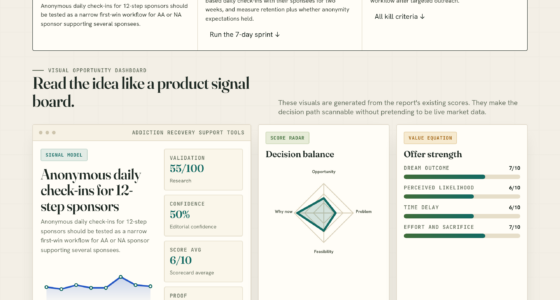

📊 Full opportunity report: Brazil: Pay the Family, Mind the Child on ThorstenMeyerAI.com — validation score, market gap, and execution plan.

Get smart everyday buys delivered free — and shop member deals
- Fast, free delivery on millions of items
- Access to Prime Big Deal Days deals on October 6–7
- Prime Video, Amazon Music and more included
TL;DR
Brazil’s government maintains its Bolsa Família program, providing conditional cash transfers to nearly 46 million people. The program aims to reduce poverty and break intergenerational cycles of inequality. Its effectiveness and limitations are under ongoing evaluation.
Brazil’s government has reaffirmed its commitment to the Bolsa Família program, continuing to provide monthly cash transfers to approximately 46 million people, roughly a quarter of the population. The program conditions families to keep children in school and ensure vaccinations and health checkups, aiming to reduce poverty and intergenerational inequality.
The Bolsa Família program, launched in 2003 and consolidated under President Lula, remains a key pillar of Brazil’s social policy. It targets low-income families using the Cadastro Único registry and delivers payments via Pix, the central bank’s instant payment system. Families must meet conditions related to child education and health to receive benefits, with the goal of investing in human capital to break the cycle of poverty.
Recent statements from government officials confirm that the program continues unchanged, with no immediate plans for major reforms. Experts note that Bolsa Família has contributed to a decline in inequality over its first decade and has been a model for similar programs worldwide, with over 40 countries adopting similar conditional cash transfer schemes. However, critics highlight ongoing issues such as the program’s modest scale and the risk of excluding the poorest families unable to meet conditions.
Pay the Family, Mind the Child
The conditional-cash-transfer pioneer: cash in exchange for human-capital investment. Relieve poverty now, break the cycle for the next generation — the model Brazil gave the world.
- a monthly cash transfer
- targeted via the CadÚnico registry
- delivered via Pix (instant, free)
- children enrolled & attending school
- vaccinations kept current
- regular health checkups
Independent commentary, produced with AI assistance under human editorial oversight. The views are the author’s own and may change. This is analysis, not policy, economic, investment, or legal advice. Descriptions of Bolsa Família and its conditionalities, the Cadastro Único, the BPC benefit, and Pix reflect publicly reported information as of mid-2026 and may change; figures are indicative and several are official or institutional estimates. This phase maps differing approaches and endorses none; characterizations of contested arrangements present competing views, not a verdict. Country, program, and company names are referenced for analysis and imply no affiliation.
Impact of Bolsa Família on Poverty and Inequality
The continuation of Bolsa Família underscores Brazil’s ongoing efforts to combat poverty and inequality through targeted social policies. The program’s conditional cash transfers have been credited with significant reductions in poverty levels and inequality, although critics argue that it has not fundamentally altered Brazil’s deep structural disparities. Its persistence signals political and social commitment to these strategies, which influence policy debates across the Global South.
Brazil Bolsa Família cash transfer guide
As an affiliate, we earn on qualifying purchases.
As an affiliate, we earn on qualifying purchases.
Brazil’s Bolsa Família was established in 2003, consolidating earlier social assistance schemes into a single, targeted program. It became the largest conditional cash transfer in the world, reaching millions of families and serving as a model for other countries. The program’s design links payments to conditions such as school attendance and health checkups, aiming to foster human capital development. Over two decades, it has contributed to reductions in poverty and inequality, with recent data indicating ongoing challenges related to structural disparities and program inclusiveness.
“We reaffirm our commitment to Bolsa Família as a vital tool in our fight against poverty and inequality.”
— Brazilian government spokesperson
child health and education monitoring tools
As an affiliate, we earn on qualifying purchases.
As an affiliate, we earn on qualifying purchases.
Unresolved Questions About Program Effectiveness and Inclusion
It remains unclear how the program will evolve in response to Brazil’s ongoing social and economic challenges. Questions persist about whether the conditionalities might exclude the most vulnerable families and how the program can be scaled or reformed to address structural inequalities more effectively. Additionally, the impact of recent political shifts on future funding and policy adjustments is still uncertain.
conditional cash transfer program resources
As an affiliate, we earn on qualifying purchases.
As an affiliate, we earn on qualifying purchases.
Future Policy Directions and Program Reforms
Brazilian authorities are expected to review and potentially adjust Bolsa Família’s conditions and outreach strategies in the coming months. Monitoring and evaluation efforts will likely focus on inclusion, effectiveness, and integration with other social policies. Policymakers may also consider reforms to expand coverage or increase benefit amounts, aiming to deepen the program’s impact on reducing inequality.
Brazil social welfare program books
As an affiliate, we earn on qualifying purchases.
As an affiliate, we earn on qualifying purchases.
Key Questions
Will Bolsa Família be expanded or reformed soon?
There are no confirmed plans for immediate expansion or major reforms, but discussions about program adjustments are ongoing within government circles.
How does Bolsa Família compare to similar programs in other countries?
It is considered one of the most successful conditional cash transfer programs globally, influencing policies in over 40 countries with its targeted, conditional approach.
What are the main criticisms of Bolsa Família?
Critics argue that the program’s modest payments and conditionalities may exclude the most vulnerable families and that it does not address the root causes of inequality.
How does the program impact children’s education and health?
Research indicates that Bolsa Família’s conditions have contributed to increased school attendance and vaccination rates among participating children.
It remains a central component of Brazil’s strategy to reduce poverty and inequality, serving as a model for conditional cash transfer schemes worldwide.
Source: ThorstenMeyerAI.com
Fall Picks
fall essentials
As an affiliate, we earn on qualifying purchases.