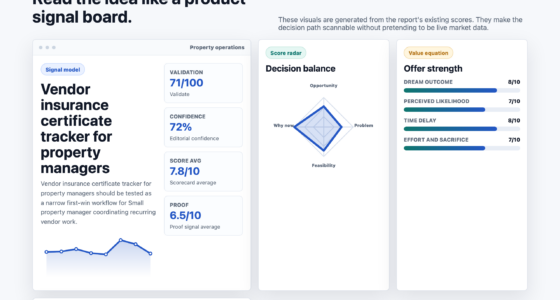

📊 Full opportunity report: QAtrial: Compliance That Shows Its Work on ThorstenMeyerAI.com — validation score, market gap, and execution plan.

Get smart everyday buys delivered free — and shop member deals
- Fast, free delivery on millions of items
- Access to Prime Big Deal Days deals on October 6–7
- Prime Video, Amazon Music and more included
TL;DR
QAtrial has unveiled a new platform designed to integrate AI into regulated life sciences workflows. It emphasizes provenance, traceability, and human review to meet strict compliance standards. The system aims to reduce manual drudgery while maintaining regulatory integrity.
QAtrial has introduced a new compliance platform that integrates AI assistance into regulated life sciences workflows, emphasizing provenance and traceability. The system aims to support companies in meeting strict regulatory requirements while reducing manual effort, marking a significant step in AI adoption within GxP environments.
The platform is aligned with regulations such as 21 CFR Part 11 and EU Annex 11. It ensures every AI-generated output—be it a CAPA, requirement link, or corrective action—is stamped with detailed provenance, including model, version, purpose, and timestamp, all reviewed and signed by a human reviewer. This creates an auditable, immutable record that addresses the core needs of regulated QA.
According to Thorsten Meyer, the platform’s creator, “Provenance is the key to making AI usable in regulated environments. Without it, AI outputs are untrustworthy and unprovable in an audit.” The system supports provider-agnostic models, like OpenAI and Anthropic, with purpose-specific routing, allowing users to deliberately select and record different models for various tasks. It also covers essential primitives such as CAPA workflows, electronic signatures, and traceability matrices, all integrated into a single platform.
QAtrial — compliance that shows its work
You can’t put an unaccountable black box into a regulated process. So every AI-assisted output records which model produced it — reviewed, e-signed, and traceable.
no validation risk
Independent commentary, produced with AI assistance under human editorial oversight. The views are the author’s own and may change. QAtrial is developed privately and is not publicly available. It is designed to align with frameworks including 21 CFR Part 11 and EU Annex 11 but is not validated, certified, or a guarantee of regulatory compliance, and is not legal or regulatory advice — computer-system validation and all regulatory obligations remain the user’s responsibility. AI-assisted outputs may contain errors and require qualified human review. Product and company names are trademarks of their respective owners; mention does not imply endorsement.
Why Provenance-First AI Is Critical for Regulated QA
This development matters because it addresses one of the main barriers to AI adoption in regulated life sciences: trust and auditability. By embedding detailed provenance and requiring human review and signatures, QAtrial ensures AI-assisted outputs can withstand regulatory scrutiny. This could significantly streamline compliance workflows, reduce manual drudgery, and improve consistency across quality processes, while maintaining the integrity required for patient safety and regulatory adherence.
AI compliance management software for life sciences
As an affiliate, we earn on qualifying purchases.
As an affiliate, we earn on qualifying purchases.
Regulated QA’s Resistance to AI and the Role of Provenance
Regulated quality assurance in life sciences relies on validated systems that produce trustworthy, tamper-proof records. Traditional systems demand detailed audit trails linking every requirement, test, and result, with strict electronic signature and change controls. AI’s potential to automate and accelerate these processes is clear, but its opacity and version variability pose compliance risks. Historically, regulators have been wary of black-box AI models lacking traceability. QAtrial’s approach—focusing on provenance and signed human review—aims to bridge this gap, making AI usable without compromising compliance.
Thorsten Meyer notes that this approach is a response to the industry’s need for transparency, saying, “Without detailed provenance, AI cannot be trusted in regulated environments. Our system makes every AI output fully attributable and reviewable.”
“Provenance is the key to making AI usable in regulated environments. Without it, AI outputs are untrustworthy and unprovable in an audit.”
— Thorsten Meyer, Creator of QAtrial
regulated industry audit trail software
As an affiliate, we earn on qualifying purchases.
As an affiliate, we earn on qualifying purchases.
Remaining Questions About QAtrial’s Regulatory Readiness
It is not yet clear how regulators will view the provenance-first approach in actual audits or if the platform’s implementation will be deemed sufficient for validation purposes. The extent to which QAtrial’s model can meet diverse regional regulatory requirements remains to be seen. Additionally, the practical adoption rate among life sciences companies and their validation strategies are still emerging.
GxP compliant electronic signature tools
As an affiliate, we earn on qualifying purchases.
As an affiliate, we earn on qualifying purchases.
Next Steps for Adoption and Regulatory Evaluation
QAtrial plans to engage with early adopters in the life sciences industry and gather feedback on real-world use cases. Further validation efforts and case studies are expected to demonstrate its compliance capabilities. Regulatory bodies may also begin reviewing the platform’s approach as part of broader discussions on AI integration in GxP environments. The company will likely focus on building partnerships to facilitate validation pathways and expand its feature set based on user feedback.
traceability and provenance tracking software
As an affiliate, we earn on qualifying purchases.
As an affiliate, we earn on qualifying purchases.
Key Questions
How does QAtrial ensure AI outputs are compliant with regulations?
QAtrial embeds detailed provenance and requires human review and electronic signatures for all AI-assisted outputs, creating an auditable trail aligned with regulations like 21 CFR Part 11 and EU Annex 11.
Is QAtrial certified or validated for use in regulated environments?
No, QAtrial is a compliance support tool that aligns with regulatory requirements but does not itself provide certification or validation. Responsibility remains with the user to validate their processes.
Can QAtrial integrate with existing quality management systems?
Yes, as a self-hosted platform, QAtrial can be integrated into existing workflows, but specific integrations would depend on user implementation and customization.
What models does QAtrial support for AI assistance?
The platform supports provider-agnostic models, including OpenAI and Anthropic, with purpose-specific routing and provenance tracking for each model used.
When will QAtrial be widely available for industry use?
The platform is currently in early deployment stages, with broader industry adoption expected after further validation and regulatory feedback over the coming months.
Source: ThorstenMeyerAI.com
Fall Picks
fall essentials
As an affiliate, we earn on qualifying purchases.