
TL;DR

Get smart everyday buys delivered free with Prime
- Fast, free delivery on millions of items
- Prime Video, Amazon Music and more included
- Member-only deals all year
IdeaClyst is a local-first tool that acts as a war room for your ideas, combining AI council debates with real-time web research. It helps founders make smarter, faster decisions before investing months or thousands of dollars.
Imagine sitting in a room, surrounded by a diverse group of advisors—each with a different perspective. Now, picture this happening inside your laptop, powered by AI. That’s the core idea behind IdeaClyst.
This isn’t just another brainstorming app. It’s a war room—your secret weapon for vetting ideas with brutal honesty and concrete data, all without leaving your desk. If you’ve ever hesitated on which startup idea to pursue, or watched a promising project flail because of overlooked flaws, this tool could change everything.
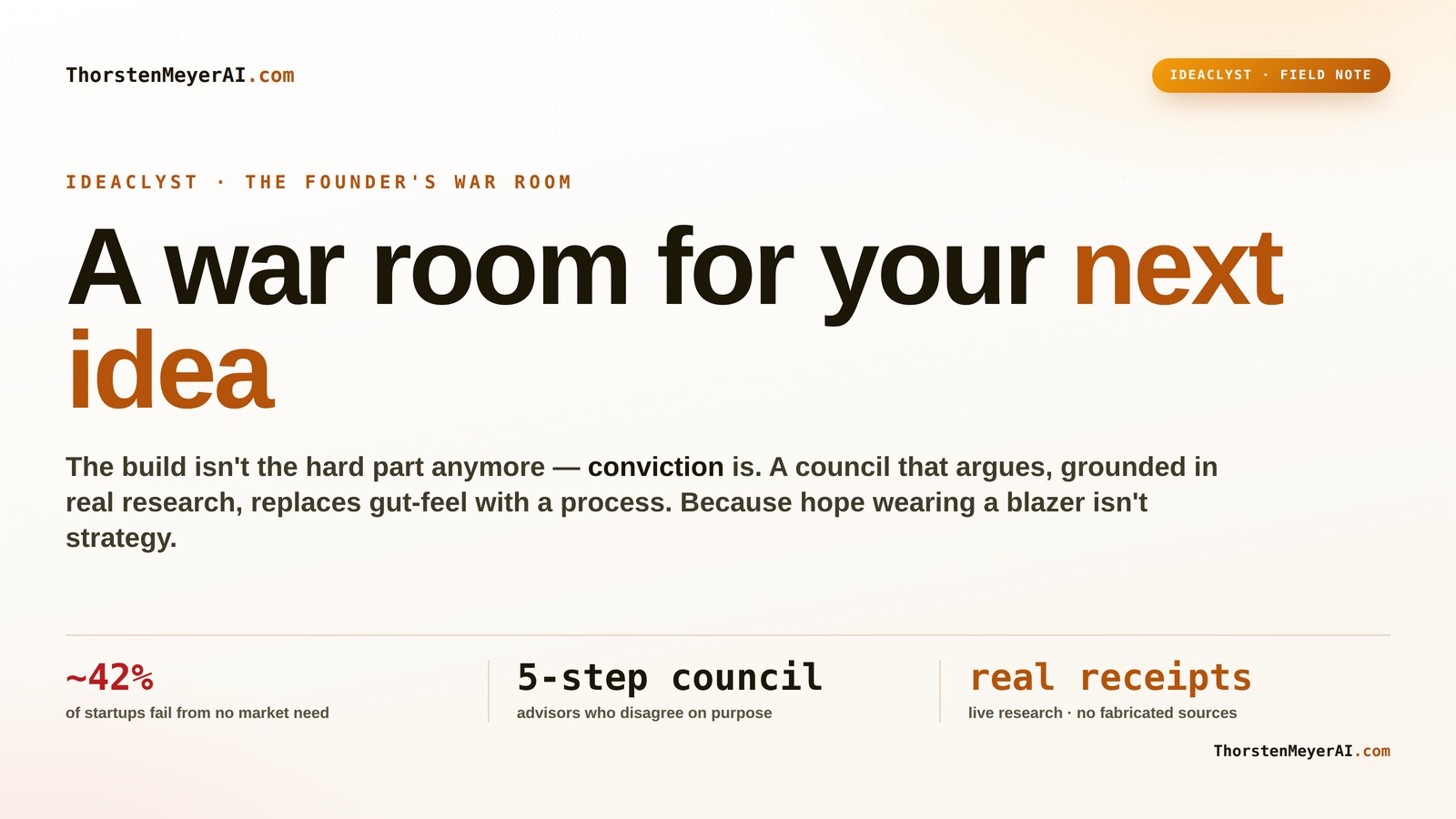
A war room for your next idea
The build isn’t the hard part anymore — conviction is. Knowing which idea deserves the next six months, and being able to defend it. Most founders answer with gut feel and optimistic math. That’s hope wearing a blazer. IdeaClyst replaces it with a process.
The most expensive decision is what to build
The single most valuable thing a tool can do is talk you out of the wrong six months. The numbers make the case better than any pitch.
Three tools in one — on your own machine
Strip away the framing and IdeaClyst is three things at once, all running locally with nothing leaving your laptop.
An AI council
Pressure-tests an idea you bring it — advisors who argue on purpose.
A discovery engine
Finds ideas you didn’t know to look for by hunting real demand signals.
A founder’s workspace
Carries winners from “interesting” all the way to “ready to build.”
Advisors who disagree on purpose
Not one confident, agreeable answer — a structured five-step deliberation where models play different roles and turn on their own work. The disagreement is the feature.
The five-step deliberation
A council that leads with the bad news surfaces the objections you’d otherwise find the expensive way, on month five.
Product strategy
Who’s it for, what’s the wedge, why now, what’s the business model.
Technical architecture
What would it actually take to build — and where’s the risk.
Critique pass
The council turns on its own work. Where’s the hand-waving? What kills this?
Second, independent critique
A different voice, a different angle — so blind spots don’t survive.
Final synthesis
Everything into one coherent founder packet: strategy, architecture, validation, plan.
When IdeaClyst cites a source, it actually fetched it
The hard departure from “ask an AI what it thinks of my startup.” It runs in a strict, real-data-only mode — if it can’t gather genuine evidence, it says so plainly rather than inventing a plausible paragraph.
Confidence with receipts
No fabricated statistics, no imaginary competitors, no made-up citations. The packet survives a skeptical co-founder or a sharp investor because the reasoning has receipts.
Market research first
Scouts the landscape before the council reasons about anything.
Competitor read
Real positioning, pricing signals, feature claims — differentiation vs. reality.
Validation with links
Not “talk to customers” — concrete signals & sources you can click.
From the blank page to build-ready
Evaluation is half the problem; the blank page is the other half. And a plan is worthless if it dies in a tab you never reopen.
Bring a space, not an idea
“AI for accountants,” “tools for indie game studios” — plus your goal and real capacity. It hunts demand signals across HN, Reddit, Product Hunt, GitHub, pricing pages.
- An honest market read — leads with the bad news when a space is hard
- An opportunity map — high pain, thin competition
- Ranked candidates — wedge, who pays, effort, risk, confidence
- each with KILL CRITERIA — when to walk away
A home and a forward path
Every promising idea gets carried forward, with every artifact in plain files on your disk.
- Validation tooling — sprint board, interview list, evidence browser
- Founder profile — a personal-fit lens; same discovery, different advice
- Build workspaces — funnel, personas, landing draft, version history
- “Build this idea” → a PRD + task queue, ready for a coding agent
Key Takeaways
- IdeaClyst’s structured debate surfaces objections and blind spots, reducing startup failure risk.
- Grounding ideas in real-time web research ensures validation is based on current, reliable data.
- The five-step process turns fuzzy concepts into clear, defendable plans in hours, not months.
- A local-first design keeps your ideas private and secure, ideal for solo founders and small teams.
- Using a debate-driven war room accelerates decision-making and minimizes costly pivots.
Products Worth Considering

HP Sprocket Photo Booth Instant Color Printer Bundle

Samsung 27-Inch Odyssey QD-OLED G8 4K 240Hz Gaming Monitor

LG UltraGear 27-Inch QHD OLED Gaming Monitor, 240Hz, 0.03ms, G-SYNC Compatible, FreeSync Premium Pro, HDMI 2.1
As an affiliate, we earn on qualifying purchases.
How IdeaClyst’s War Room Turns Ideas into Actionable Plans
IdeaClyst’s core strength is turning fuzzy concepts into clear, defendable strategies. It’s like having a team of skeptics and experts arguing your corner, but all inside your computer. You can learn more about payment processing, fraud prevention, and payment operations strategies on The Event Within.
It starts with you dropping an idea—say, a new SaaS product or a marketing campaign. Then, the tool runs a structured five-step debate, where different AI models play the roles of strategists, engineers, and critics. Discover more about AI tooling for idea validation.
For example, it’ll ask: Who’s the customer? What’s the wedge? What are the technical risks? Each step surfaces blind spots, weak assumptions, and hidden opportunities. The final result? A comprehensive, Markdown-formatted plan you can review, share, and refine.
Understanding this process matters because it ensures that every aspect of your idea undergoes rigorous scrutiny. This systematic approach reduces the likelihood of overlooking critical flaws that could doom your project later. The tradeoff is that while it takes time upfront, it ultimately saves you from costly pivots or failed launches, making your planning more resilient and well-founded.
Why a Debate-Driven AI Council Beats Single-Opinion Tools
Ever tried talking to a chatbot that simply agrees with you? It’s comforting but useless for serious validation. IdeaClyst’s genius is in its **diverse viewpoints**. It stages a structured five-step debate between models playing different roles, intentionally creating disagreement.
This approach surfaces objections, unearths overlooked risks, and challenges your assumptions. It’s like having a panel of skeptics who push back until only the strongest ideas survive. For more insights into industry debates, visit Daily Coin Feed.
According to research, ideas confirmed by multiple, conflicting perspectives are 30% more likely to succeed because they’ve been stress-tested from every angle. This multi-perspective debate is crucial because it exposes vulnerabilities that a single opinion might miss, such as hidden market barriers, technical feasibility issues, or overlooked customer needs. The tradeoff, however, is that this process requires more cognitive effort and trust in the system to weigh conflicting viewpoints—yet the payoff is significantly increased confidence in your final plan, reducing the risk of costly mistakes.
The Five Steps of IdeaClyst’s Debate That Save You Time and Money
| Step | What It Does |
|---|---|
| 1. Strategy | Defines target customer, market fit, and business model. This step ensures you’re aligned with real market needs, preventing the costly mistake of building a product nobody wants or that doesn’t fit the market landscape. |
| 2. Architecture | Assesses technical feasibility and risks. It’s critical because technical hurdles can derail a project if overlooked early, leading to wasted development time and resources. Addressing these risks upfront allows for better planning and resource allocation. |
| 3. Critique | Identifies assumptions and weak points. This step forces you to confront your biases and untested beliefs, which often hide behind optimism. Recognizing these assumptions early can prevent later failures and pivots that are costly both financially and in time. |
| 4. Independent Critique | Provides fresh perspectives to catch overlooked flaws. Having diverse viewpoints reduces groupthink and uncovers risks that your team might dismiss. It’s a safeguard that enhances the robustness of your plan, but it also means you need to be open to criticism that might challenge your core ideas. |
| 5. Synthesis | Consolidates insights into a final, actionable plan. This step ensures clarity and focus, translating debate outputs into concrete next steps. The implication is that your idea is now well-rounded and ready for execution, reducing ambiguity that can cause delays or misaligned efforts. |
This process takes an idea from fuzzy concept to a solid plan in just hours, not months. It’s a tradeoff: faster validation, but with a need for disciplined engagement and honest critique to truly benefit from the method.
Grounding Ideas in Real Data, Not Just Model Vibes
Many AI tools give you vague, confidence-filled responses that aren’t backed by evidence. IdeaClyst’s secret weapon is its grounding in live web research. It pulls real-time data, market stats, and competitive intelligence, ensuring every critique is rooted in facts.
For example, say you’re exploring a new telehealth platform. Instead of guessing market growth, IdeaClyst pulls current statistics—like the 25% annual growth rate in telehealth services in 2026—and uses that to inform the debate.
This approach helps avoid the biggest trap: trusting confident opinions without evidence. It’s like having a mini research team working in tandem with your debates. This integration of live data not only increases the accuracy of the validation but also allows you to adapt your ideas dynamically as market conditions evolve, which is crucial in fast-changing industries.
How to Use IdeaClyst as Your Personal Startup War Room
- Write down your idea clearly—one sentence or a short paragraph.
- Input it into IdeaClyst’s interface.
- Let the AI council run its five-step debate.
- Review the structured report—strategy, architecture, critiques, final plan.
- Refine your idea with the feedback, then decide whether to build or pivot.
For example, I used it to evaluate a new SaaS feature. The debate revealed a hidden technical risk I hadn’t considered. That saved me from months of wasted development. Learn more about cryptocurrency news and analysis for industry insights.
Who Should Use IdeaClyst—and Why It’s for Everyone
Founders, product managers, marketers, and solo creators all benefit from using IdeaClyst as their personal startup war room.t from IdeaClyst. If you’re making decisions that could cost months of work or thousands of dollars, this tool can help you validate fast.
It’s especially useful if you’re working alone or with a small team. The local-first design means your ideas stay private, secure, and accessible offline. Think of it as your personal, always-on war room.
For example, a solo founder building a new app used IdeaClyst to validate the core market assumptions before even writing a line of code.
Turning Ideas into Action: From Debate to Building
Validation is only the first step. IdeaClyst helps you turn a well-vetted idea into a concrete plan. Once the debate concludes, you have a clear roadmap—what to build, how to test, and what to watch out for.
For instance, after a rigorous debate on a new feature, you might have a prioritized list of MVP components and validation tests. This roadmap guides your development process, saving time and avoiding costly pivots.
Frequently Asked Questions
What is IdeaClyst?
IdeaClyst is a local-first, AI-powered tool that acts as a structured debate and validation war room for your startup ideas. It helps you pressure-test concepts through a multi-model council, grounded in real-time research.How does a war room help generate better ideas?
A war room creates a focused environment where different perspectives clash and converge. This process surfaces hidden risks, assumptions, and opportunities, making your ideas stronger and more ready for execution.Is IdeaClyst suitable for solo founders?
Absolutely. Its local-first design means your ideas stay on your machine, perfect for solo entrepreneurs who want privacy and control while still benefiting from structured, debate-driven validation.Can I turn validated ideas into actual products fast?
Yes. By grounding ideas in real data and surfacing risks early, IdeaClyst helps you develop clear, actionable roadmaps—so you can move from concept to product more efficiently.Conclusion
Building your next big idea doesn’t have to be a leap in the dark. With IdeaClyst, you create a personal war room that rigorously tests your assumptions, grounds your plans in real data, and helps you move faster. It’s the secret weapon every founder needs to avoid costly missteps and confidently ship what truly matters.
Think of it as your own courtroom of ideas—where the best survive scrutiny. The question is: which idea will you defend first?