
TL;DR

Get smart everyday buys delivered free with Prime
- Fast, free delivery on millions of items
- Prime Video, Amazon Music and more included
- Member-only deals all year
Apple announced the Mac Studio with up to 512GB of unified memory, enabling it to load frontier-scale AI models locally. While capable of loading large models, performance for inference at scale remains limited by bandwidth and compute. This development offers a new option for small-scale AI work, but is not a replacement for data center GPUs.
Apple announced the Mac Studio on August 25, 2026, featuring a new up to 512GB of unified memory and a GPU designed to support large AI models locally. This development provides an option for AI researchers and small teams to run frontier-scale models without relying solely on cloud infrastructure, potentially facilitating local experimentation.
The Mac Studio is available in two configurations: the M5 Max with up to 128GB of memory and the M5 Ultra with up to 512GB of unified memory. The latter, starting at $5,499, can be configured with 512GB of RAM for over $10,000, making it one of the most memory-rich desktop machines on the market. The design integrates two M5 Max chips via Apple’s UltraFusion interconnect, creating a single, high-performance processor with neural acceleration capabilities.
Apple claims the M5 Ultra offers up to 4.3 times faster AI performance than the previous M3 Ultra and nearly 10 times faster than the M1 Ultra in some benchmarks. The large unified memory pool allows the GPU to directly access 512GB of memory—an extensive capacity for a desktop machine—enabling it to load large models that previously required data center GPUs.
However, experts note that loading a large model is different from running it efficiently. The machine’s bandwidth of 1.2 terabytes per second, while substantial for a desktop, is still less than what high-end datacenter GPUs provide, which may limit inference speeds primarily to experimentation and small-scale deployment rather than high-throughput, multi-user scenarios.
Implications for Personal AI Model Development
This development could influence how AI models are experimented with and deployed on individual hardware. For researchers, hobbyists, or small teams, the ability to load and work with large models locally can reduce reliance on cloud services, potentially enhancing privacy and control, and may lower operational costs. It also supports privacy-sensitive applications where data remains on local hardware.
Nonetheless, the machine’s performance is constrained by bandwidth and computational capacity. While capable of loading large models, its inference speed and throughput are not comparable to dedicated data center GPUs optimized for large-scale deployment. It should be viewed as a workstation suitable for development and small-scale inference rather than a replacement for professional server infrastructure.
As an affiliate, we earn on qualifying purchases.
Advances in Desktop AI Hardware and Market Trends
Historically, running large AI models locally has been limited to specialized hardware, often costly and less accessible. Cloud providers have dominated large-scale AI inference with scalable GPU clusters. The recent introduction of more powerful consumer-grade hardware, such as the Apple Mac Studio, indicates a shift toward more accessible local AI experimentation. Apple’s integration of neural accelerators and large unified memory reflects broader industry efforts to democratize access to large models, though practical performance varies depending on workload and hardware limitations.
Previous Apple Silicon chips, like the M1 Ultra, demonstrated high-performance desktop AI capabilities, but the new M5 Ultra’s increased memory capacity significantly enhances this potential. While these advancements do not replace the need for data center infrastructure for large-scale deployment, they represent a step toward more accessible AI research environments at the desktop level.
“Loading a big model and serving it fast are different achievements, and this machine excels at the first, but performance for inference remains bounded by bandwidth and compute.”
— Thorsten Meyer
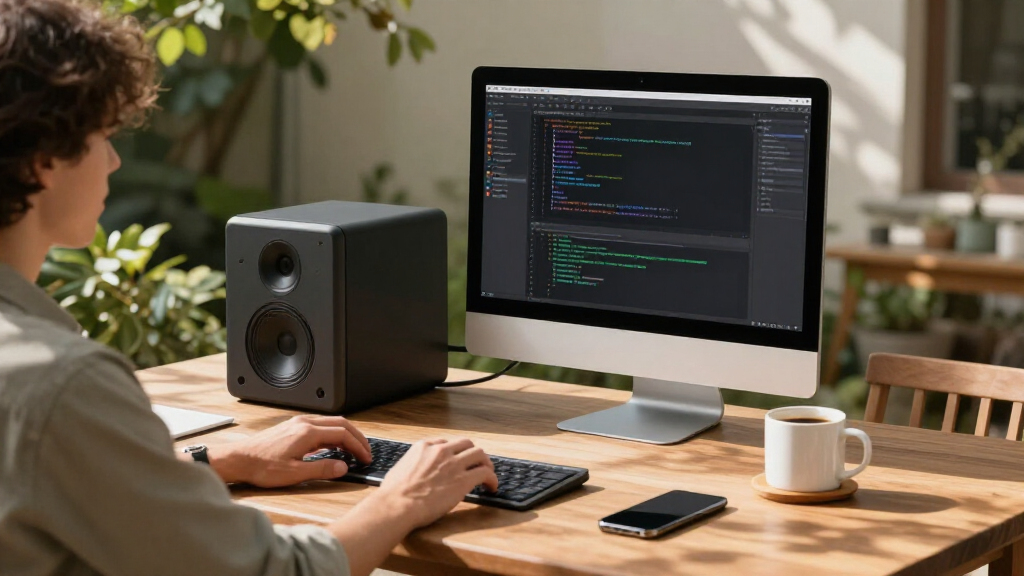
AI development workstation Mac Studio
As an affiliate, we earn on qualifying purchases.
As an affiliate, we earn on qualifying purchases.
Performance Limitations for Large-Scale Inference
While the machine can load large models, real-world inference speeds for complex models at scale have not been extensively tested outside of Apple’s benchmarks. Independent benchmarks on actual workloads are awaited to assess performance in practical scenarios, particularly for multi-user or high-throughput applications. Additionally, the maturity and compatibility of the software ecosystem with existing AI frameworks are still evolving, which may influence ease of use for some workflows.
As an affiliate, we earn on qualifying purchases.
Upcoming Benchmarks and Software Ecosystem Maturity
Independent testing of the Mac Studio’s inference performance is expected in the coming months, which will help determine its suitability for various AI workloads. Apple is likely to continue refining its machine learning tools and ecosystem, but early adopters should anticipate some adaptation work. The release of the high-memory model in late October will provide additional options for users with demanding AI needs.
As an affiliate, we earn on qualifying purchases.
Key Questions
Can the Mac Studio run large AI models faster than cloud GPUs?
While it can load large models due to its 512GB unified memory, inference speed is limited by bandwidth and compute, making it suitable mainly for experimentation rather than high-speed, large-scale deployment.
Is the Mac Studio a replacement for data center GPUs?
No, it is designed for local development and small-scale inference, not for serving many users or high-throughput AI applications at scale.
What workloads are best suited for this machine?
Research, development, privacy-sensitive inference, and small-team AI experiments are ideal, leveraging its large memory capacity for loading models locally.
Will software support mature enough for all AI frameworks?
While Apple’s ML ecosystem has improved, some workflows may require porting or alternative tools, and full compatibility with all AI frameworks is still evolving.
When will the high-memory configuration be available?
The 512GB model is expected to ship in late October 2026, following the initial release of the base configuration.
Source: ThorstenMeyerAI.com
Fall Picks
fall essentials
As an affiliate, we earn on qualifying purchases.