
📊 Full opportunity report: A Scanner For Small Offices That Need To Manage More Paper on IdeaNavigator AI — validation score, market gap, and execution plan.

Get smart everyday buys delivered free with Prime
- Fast, free delivery on millions of items
- Prime Video, Amazon Music and more included
- Member-only deals all year
TL;DR
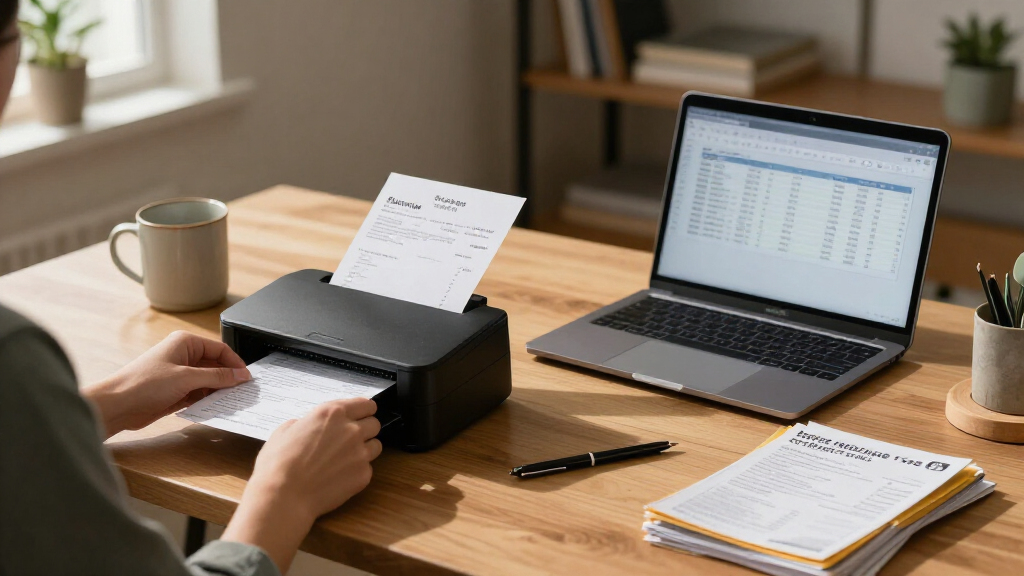
IdeaNavigator AI has outlined a proposed phone-based scanner for small offices that would classify documents, suggest filenames and save searchable PDFs to a shared folder. The concept has not been reported as a launched or tested product; its proposed next step is a one-week pilot at five offices.
IdeaNavigator AI has proposed a pilot for a phone-based document scanner that would automatically sort and name paperwork for small offices, addressing a routine filing burden at nonprofits, clinics and law firms. The concept remains at the testing stage: no product launch, pilot results or measured accuracy have been reported, according to the proposal published by IdeaNavigator AI.
According to IdeaNavigator AI’s proposal, the app would let an office worker photograph a stack of documents on a phone. It would use optical character recognition (OCR) to read the pages, suggest a document category and filename, and save each item as a searchable PDF in a shared folder. An example naming format would combine an invoice label, date and vendor.
The proposal targets offices that handle intake forms, invoices and records but may lack dedicated IT staff. It argues that generic scanning tools can produce digital images without useful names or extracted information, leaving workers to sort and file documents manually. The proposal points to newer on-device and API-based OCR and layout-aware models as a possible way to make automated processing affordable; this is a rationale for testing, not a demonstrated performance result.
To evaluate the concept, IdeaNavigator AI’s proposal calls for a one-week pilot at five small offices. Each office would scan a real backlog of 200 documents. The suggested measures are the rate of correct automatic classification and whether offices would pay a per-seat subscription. The proposal does not identify participating offices, pilot dates, accuracy thresholds or willingness-to-pay results.
Reducing Manual Filing Work
For a small office, the practical promise is not simply converting paper into images. It is making records searchable and easier to retrieve without assigning staff to name and sort every file. If classification and field extraction work reliably, the workflow could reduce repetitive administrative work and make a backlog more usable.
But errors could undermine that benefit. A misclassified invoice or intake form may be harder to find than a paper document stored in a known cabinet, and sensitive records at clinics or law firms raise questions about who can access uploaded files. IdeaNavigator AI’s proposal describes a possible workflow, not evidence that it saves time, meets privacy requirements or handles mistakes safely.
portable document scanner for small office
As an affiliate, we earn on qualifying purchases.
As an affiliate, we earn on qualifying purchases.
From Scanning to Filing
The proposed product sits between a basic scanning app and a document-management system. A conventional scanner can create a digital copy, while this concept adds automatic naming, categorization and searchable text. IdeaNavigator AI frames its target as a narrow workflow in small organizations, rather than a general-purpose tool for every business.
The proposal describes a monthly per-seat subscription with a page-volume cap and extra charges for usage above that limit. It says the pilot would test willingness to pay alongside classification accuracy, but supplies no price, page allowance or comparison with existing products. The plan therefore describes what to investigate, rather than a validated market or established pricing model.
As an affiliate, we earn on qualifying purchases.
Accuracy, Privacy and Demand
Several important details remain unknown because IdeaNavigator AI has not reported pilot findings. There is no measured classification accuracy, evidence about performance on different document layouts or confirmation that extracted names, dates and vendor details would be dependable. The proposal also does not specify how users would review or correct errors.
It is unclear whether documents would be processed entirely on a phone or sent to an external service, how long files or extracted data would be retained, and what security controls would protect records. Those questions matter particularly for clinics and law offices, which may handle sensitive information. The proposal does not establish compliance with any privacy or records-handling requirements.
Commercial demand is also unconfirmed. IdeaNavigator AI provides no subscription price, page-volume cap, customer commitments or willingness-to-pay results. The planned pilot, as described in its proposal, would offer an initial indication, but five offices and a one-week test would not by themselves establish broad demand or long-term reliability.
As an affiliate, we earn on qualifying purchases.
A Five-Office Pilot
IdeaNavigator AI’s proposal identifies recruiting five small offices as the next step and asks each to process 200 documents from an actual backlog during a one-week pilot. Organizers would then assess the rate of correct classification and ask whether participating offices would pay per seat. The proposal announces no timetable, recruitment details or criteria for a successful result.
Any reported findings would help show whether the central workflow merits further development, but readers would need more information before judging the product’s suitability: error rates by document type, correction procedures, data handling and proposed pricing. Until such results are available, the scanner is best understood as a testable product concept rather than a released office tool.
Source: IdeaNavigator AI proposal
automatic document classification scanner
As an affiliate, we earn on qualifying purchases.
As an affiliate, we earn on qualifying purchases.
Key Questions
Has the scanner app launched?
No launch is reported. IdeaNavigator AI describes the scanner as a proposed concept, with a pilot at five small offices as the suggested next step.
What would the app do?
Under IdeaNavigator AI’s proposal, users would photograph documents with a phone. The app would use OCR to read them, suggest a document type and filename, and save searchable PDFs in a shared folder.
How would the proposed pilot work?
The proposal calls for a one-week test at five offices, with each office scanning 200 documents from a real backlog. Its proposed measures are classification accuracy and willingness to pay per seat.
Does the proposal establish that the app is accurate or secure?
No. IdeaNavigator AI reports no accuracy results or security details. Data processing, retention, access controls and error correction remain unspecified.
How might the service charge customers?
The proposal suggests a monthly per-seat subscription with a page-volume cap and overage pricing. It reports no prices or customer commitments.
Source: IdeaNavigator AI
Halloween Picks
halloween
As an affiliate, we earn on qualifying purchases.