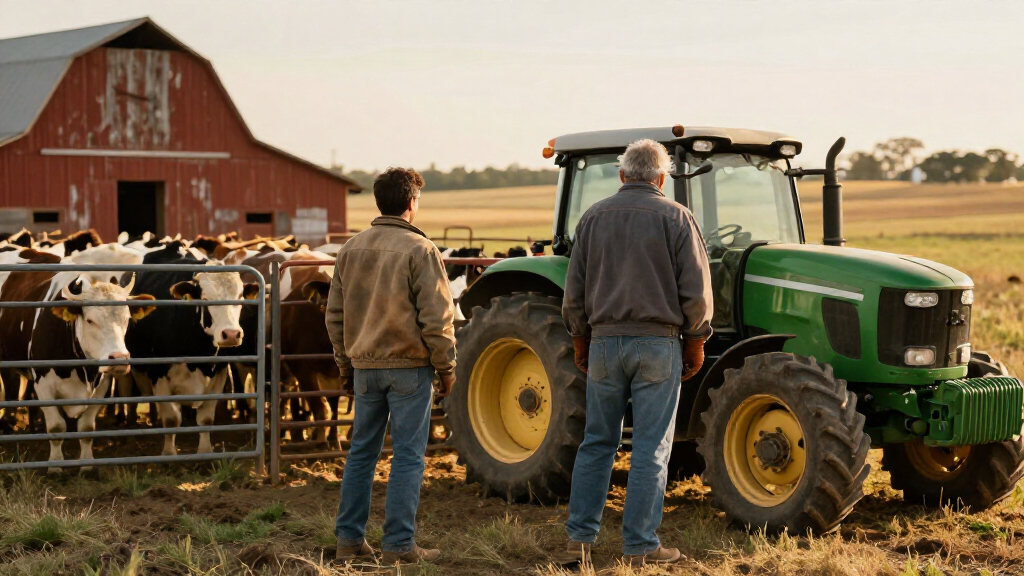

🔍 Read the full analysis: A Changing Farm: Horses, Tractors, And Millions Of Animals on ThorstenMeyerAI.com

Get smart everyday buys delivered free with Prime
- Fast, free delivery on millions of items
- Prime Video, Amazon Music and more included
- Member-only deals all year
TL;DR
A November 4, 2026, episode from ThorstenMeyerAI.com examines how tractors displaced horses and mules on American farms during the 20th century. Farm horses and mules fell from 26.7 million in 1918 to 3.1 million in 1960, while mechanization changed farm employment and freed land previously used to grow animal feed. The episode presents the history as a possible analogy for automation’s effects on workers, not as proof of what will happen to people.
ThorstenMeyerAI.com published a new episode on November 4 examining how tractors replaced horses and mules on U.S. farms, a shift that reduced the working animal population from 26.7 million in 1918 to 3.1 million in 1960. The episode uses the change as historical context for debates about automation and employment, while stressing that the comparison between horses and human workers has limits.
The episode draws on historical statistics compiled by the U.S. Census Bureau from Department of Agriculture estimates. Horses alone peaked at 21.4 million in 1915; the combined number of horses and mules reached 26.7 million on January 1, 1918. In 1915, farmers grew feed for those animals on about 93 million acres, more than a quarter of the 340 million harvested cropland acres cited in the source.
Tractor adoption accelerated over the following decades. The source counts about 1,000 tractors on U.S. farms in 1910, 246,000 in 1920 and 4.69 million in 1960. Around 1955, tractors outnumbered horses and mules for the first time, according to the episode’s cited figures. By 1960, the farm animal count had fallen to 3.1 million, and land used to grow feed had declined to about five million acres.
The episode also tracks changes in farm labor and productivity. U.S. farm employment peaked at 13.6 million in 1916 and stood at 4.5 million in 1970, while the overall labor force doubled, according to the source. The Department of Agriculture’s estimate of the number of people supplied by one farm worker rose from 7.1 in 1910 to 47.1 in 1970; that last figure includes people abroad supplied through exports.
What Mechanization Changed on Farms
The historical shift was not just a change in the source of farm power. Replacing working animals also reduced the acreage devoted to their feed: the source reports a fall from 93 million acres in 1915 to about five million in 1960. That land could instead support crops for people or sale, while tractors did not need to be fed year-round when idle.
For workers, the figures show that agricultural employment contracted as output per worker rose. They do not, on their own, establish what happened to every person who left farming or prove that later automation will produce the same pattern. The episode says many new jobs were in cities, requiring people to move, and frames the horse as a cautionary analogy rather than a prediction.
Products Worth Considering

Samsung Odyssey G4 25-inch FHD Gaming Monitor

Dell XPS 13 9350 Copilot+ Laptop, 13.4-inch 120Hz Display, Intel Core Ultra 7 256V, 16GB RAM, 512GB SSD, Ubuntu Linux 24.04 LTS

Logitech MX Master 4 for Mac Wireless Ergonomic Mouse, Space Black
As an affiliate, we earn on qualifying purchases.
From Fordson to Farm Automation
Gasoline tractors existed before World War I, but the episode says early models were heavy and costly. In 1917, Ford launched the Fordson. The Henry Ford museum describes it as “the first mass-produced and inexpensive lightweight tractor” and says it was designed for smaller farmers. The source reports that the 100,000th Fordson left the assembly line on February 21, 1920.
Other machines extended the change beyond ploughing. Combine harvesters, which cut, thresh and clean grain in one pass, increased from about 4,000 in 1920 to 1.042 million in 1960, according to the episode. Corn pickers, balers and milking machines also spread. In a current example, the source says John Deere introduced a 16-camera autonomy kit in February 2025 for tillage on select large tractors. It also reports China’s estimate that about 74% of ploughing, sowing and harvesting was mechanized in 2023.
In 1983, economist Wassily Leontief compared workers to horses replaced by tractors. The episode notes a difference Leontief himself identified: horses could not vote. That distinction is central to why the past cannot be treated as a direct forecast of the effects of automation on people.
Where the Horse Analogy Falls Short
The source presents the horse-to-tractor story as a historical comparison, not a settled model for future employment. It does not provide detailed evidence tracing the later occupations or experiences of individual farm workers. A decline in agricultural employment alongside a growing labor force shows a broad shift, but does not by itself establish how automation affected particular workers or communities.
The current technology examples are also limited in scope. The source describes John Deere’s autonomy kit as serving tillage on select large tractors, not as a system that can perform every farm task without people. It gives China’s 2023 mechanization estimate, but does not set out the measure’s methodology or a directly comparable figure for other countries. The historical tractor counts also use census years with somewhat different dates; from 1951, horses and mules were counted together.
The Next Test for Farm Robots
The episode points readers toward the capabilities and limits of present-day farm automation, including driverless tractors and the tasks they can handle. The source does not announce a new rollout, a future release date or a forecast for how quickly farm robots will spread. Any broader conclusion about employment will depend on evidence beyond the historical horse and tractor counts.
For the historical record, the cited annual estimates of farm horses and mules ended soon after their numbers had fallen sharply. The episode’s comparison with modern automation is therefore best read as a prompt for further scrutiny: which jobs machines can take over, what new work follows, and whether workers can move into it. Those outcomes remain open rather than established by the farm’s earlier mechanization.
Key Questions
When did horses and mules peak on U.S. farms?
The source’s historical figures put the combined peak at 26.7 million on January 1, 1918. Horses alone had peaked at 21.4 million in 1915.
How many farm horses and mules remained by 1960?
The episode reports 3.1 million in 1960, down from 26.7 million in 1918. It says farmers stopped breeding replacements and the working population gradually aged out.
When did tractors outnumber horses and mules?
According to the figures cited in the episode, the crossover occurred around 1955: 4.35 million tractors compared with 4.31 million horses and mules.
Does the horse story show what automation will do to human workers?
No. The episode presents it as an analogy, not a law or prediction. It notes that workers differ from horses in having political rights, and the historical figures do not establish the effects of current automation on specific jobs or communities.
What farm automation examples does the episode cite today?
The source says John Deere’s 16-camera autonomy kit, introduced in February 2025, handles tillage on select large tractors. It also reports China’s estimate that about 74% of ploughing, sowing and harvesting was mechanized in 2023.
Source: ThorstenMeyerAI.com