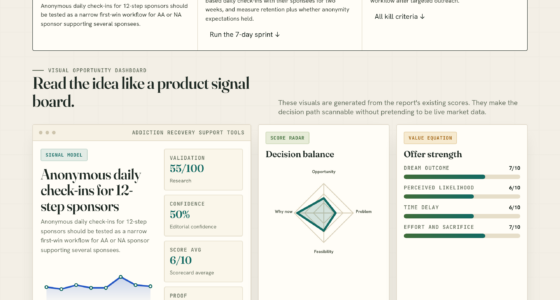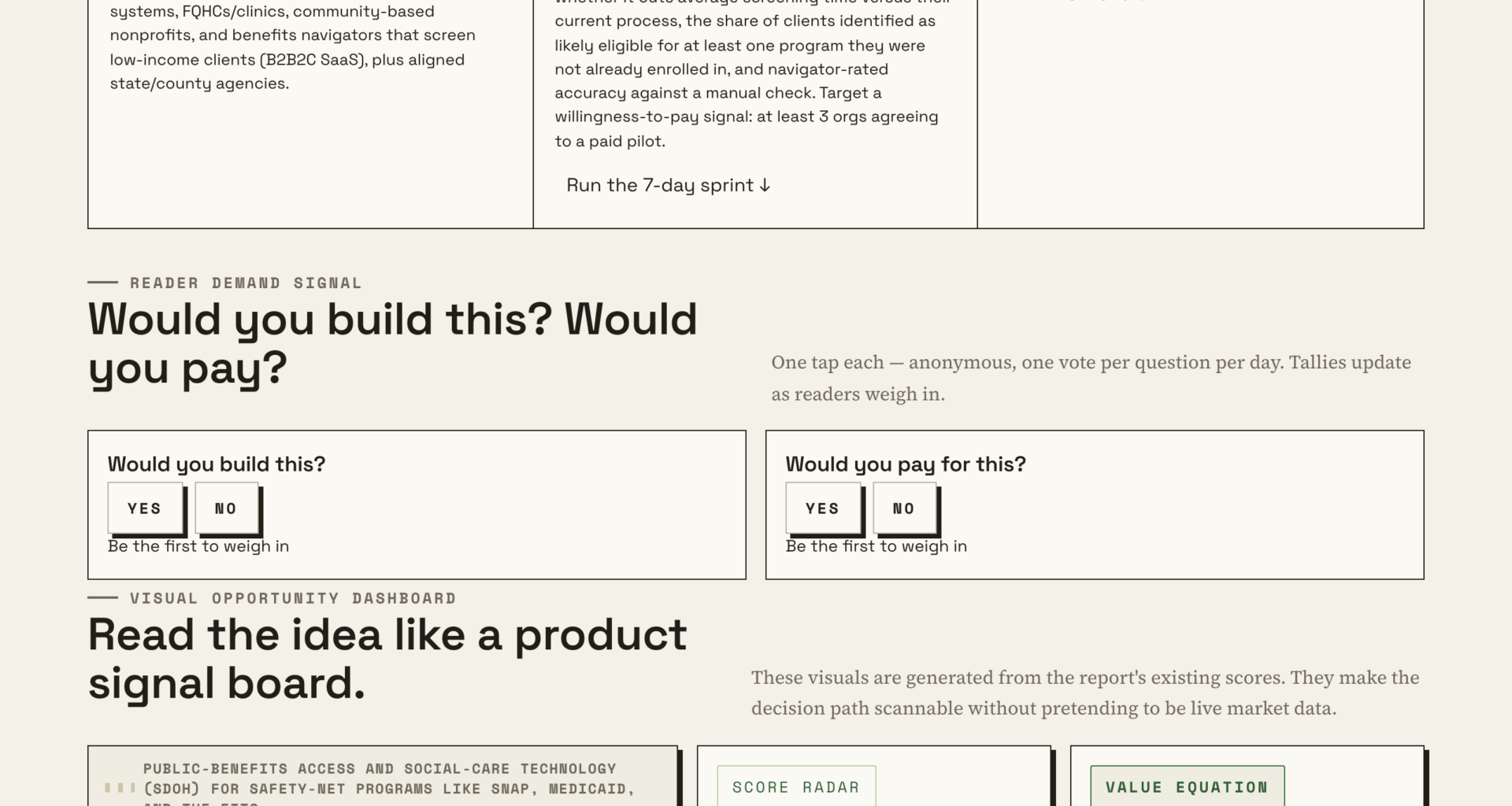

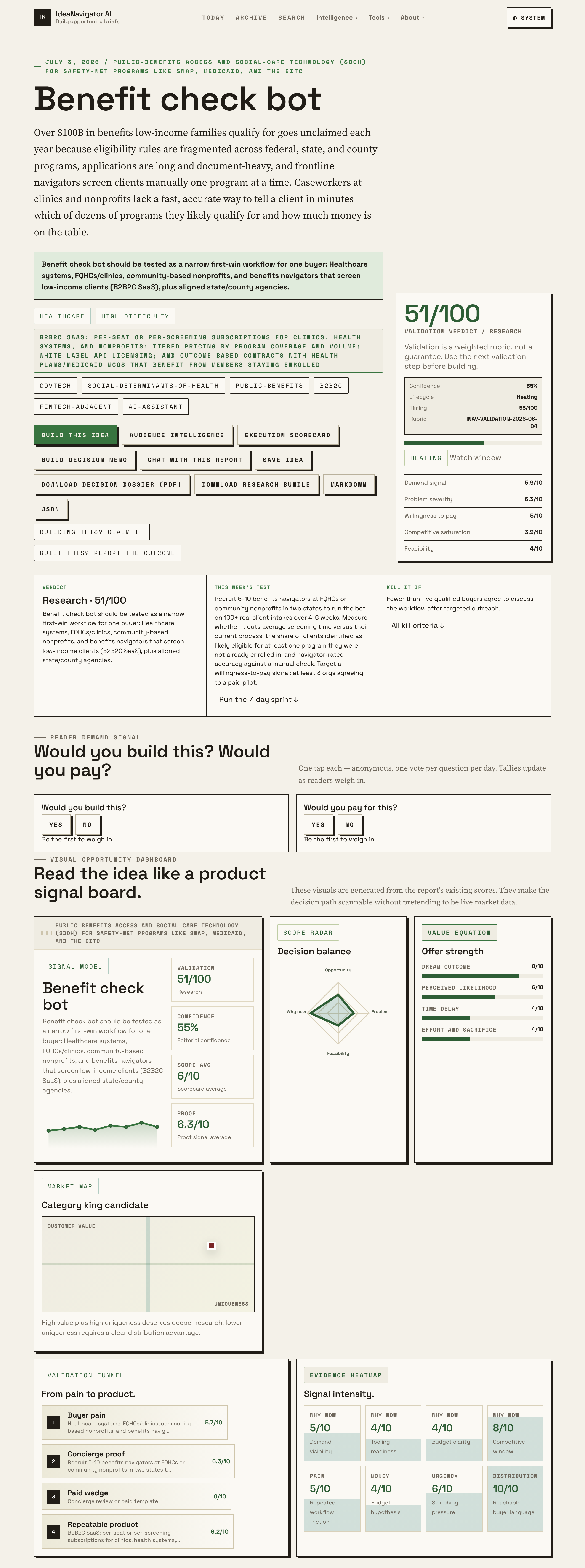
📊 Full opportunity report: The Impact Of Benefit Check Bots On Medicaid And SNAP Accessibility on IdeaNavigator AI — validation score, market gap, and execution plan.

Get smart everyday buys delivered free with Prime
- Fast, free delivery on millions of items
- Prime Video, Amazon Music and more included
- Member-only deals all year
TL;DR
Benefit check bots are being tested to enhance eligibility screening for Medicaid and SNAP, potentially increasing benefit access and reducing manual effort for providers. Their deployment follows recent shifts in benefits enrollment and concerns over unclaimed benefits.
Benefit check bots are being piloted to streamline eligibility screening for Medicaid, SNAP, and other social programs, aiming to address long-standing access gaps for low-income families. These AI-powered tools are designed for healthcare providers, community nonprofits, and state agencies to quickly identify benefits clients may qualify for, reducing manual effort and increasing benefit uptake.
Recent efforts to improve access to federal, state, and local benefits have highlighted the potential of conversational AI to transform eligibility screening processes. The benefit check bot, a white-label web and SMS tool, is being tested across several states with the goal of providing fast, accurate benefit estimates for programs such as SNAP, Medicaid, EITC, and LIHEAP. The tool asks clients a short series of yes/no and multiple-choice questions, then generates a list of likely-eligible programs with benefit estimates and next-step application links.
This initiative responds to the significant gap in benefits enrollment, with estimates suggesting over $100 billion annually in benefits go unclaimed due to fragmented eligibility rules, lengthy applications, and manual screening processes. The shutdown of Benefits Data Trust in 2024, a nonprofit that had been assisting with enrollment across seven states, has further increased the need for scalable, automated solutions. The redetermination process following the COVID-19 pandemic has also strained existing manual systems, creating delays and eligibility errors.
Early pilot programs involve 5-10 benefits navigators at community clinics and nonprofits who will run the bot on over 100 client intakes over the next 4-6 weeks. Metrics being tracked include reductions in screening time, the share of clients identified as likely eligible for new benefits, and navigator-rated accuracy compared to manual assessments. The goal is to demonstrate that the tool can deliver reliable results at near-zero marginal cost, with potential for widespread adoption if successful.
Potential to Significantly Increase Benefits Access
The deployment of benefit check bots could transform how low-income individuals access social programs, potentially unlocking hundreds of billions in unclaimed benefits annually. By rapidly identifying eligibility across multiple programs, these tools can reduce barriers such as complex applications and long wait times, leading to higher enrollment rates. This has implications for reducing poverty and health disparities, as more eligible families receive crucial support faster. Additionally, for health systems and community organizations, these tools promise to reduce staff workload and improve efficiency, allowing frontline workers to focus on complex cases that require human intervention.
Experts note that automating eligibility screening aligns with broader trends toward digital social determinants of health (SDOH) interventions, integrating benefits access into healthcare workflows. However, questions remain about the accuracy, privacy, and equitable access of these AI tools, especially in multilingual and underserved populations. If proven effective, benefit check bots could become a standard component of social care technology, reshaping the landscape of benefits enrollment and social support services.
As an affiliate, we earn on qualifying purchases.
Background on Benefits Access Challenges and AI Solutions
Over the past decade, efforts to improve benefits access have faced persistent hurdles: eligibility rules are fragmented across federal, state, and local programs; applications are often lengthy and document-heavy; and caseworkers and navigators rely heavily on manual screening processes. These factors contribute to an estimated $100 billion in benefits remaining unclaimed each year, according to various estimates.
The shutdown of Benefits Data Trust in early 2024, a nonprofit that had been assisting with enrollment in seven states, left a significant gap in outsourced benefits screening capacity. Meanwhile, the post-pandemic Medicaid redetermination process has increased the workload for state agencies and providers, leading to delays and eligibility errors. To address these issues, tech developers and policymakers have explored AI-driven solutions, with conversational bots emerging as a promising approach due to their ability to handle complex, multilingual interactions at low cost.
Recent advances in conversational AI, driven by large language models and improved natural language understanding, have made it feasible to develop tools that can accurately and efficiently screen clients for multiple benefits simultaneously. Pilot programs are now underway to test these tools’ effectiveness in real-world settings, with initial results expected in the coming months.
As an affiliate, we earn on qualifying purchases.
Uncertainties Around Accuracy and Equity of AI Screening
It remains unclear how accurately the benefit check bots will perform across diverse populations, especially in non-English speaking communities or those with limited digital literacy. While early pilots show promise, comprehensive validation results are still pending. Additionally, questions persist regarding data privacy, consent, and the potential for algorithmic bias to influence eligibility assessments. The scalability and integration of these tools into existing workflows are also still being tested, with some organizations expressing caution about relying solely on AI for benefits determinations.
benefit eligibility assessment app
As an affiliate, we earn on qualifying purchases.
As an affiliate, we earn on qualifying purchases.
Next Steps for Pilot Evaluation and Broader Adoption
In the coming months, pilot programs will collect data on screening accuracy, time savings, and client outcomes. If results are favorable, developers plan to expand the tool to additional states and programs, with potential for integration into Medicaid, SNAP, and other benefits portals. Policymakers and advocates will closely monitor the pilots to assess regulatory and privacy implications. Successful validation could lead to broader deployment, potentially transforming benefits access for millions of low-income Americans.
social program benefits calculator
As an affiliate, we earn on qualifying purchases.
As an affiliate, we earn on qualifying purchases.
Key Questions
How do benefit check bots work?
They are conversational AI tools that ask clients a series of questions to estimate eligibility for various social programs, providing a list of likely benefits and next steps for application.
Will these tools replace human benefits navigators?
They are intended to supplement, not replace, human staff by handling routine screening and freeing up resources for complex cases.
Are benefit check bots accurate and reliable?
Early pilots show promising results, but comprehensive validation is ongoing to confirm accuracy across diverse populations and settings.
Data privacy and consent are key issues, with developers working to ensure compliance with regulations and safeguard client information.
Can benefit check bots increase benefits enrollment?
Yes, by quickly identifying benefits clients may qualify for, these tools have the potential to significantly boost enrollment rates and reduce unclaimed benefits.
Source: IdeaNavigator AI
Halloween Picks
halloween
As an affiliate, we earn on qualifying purchases.