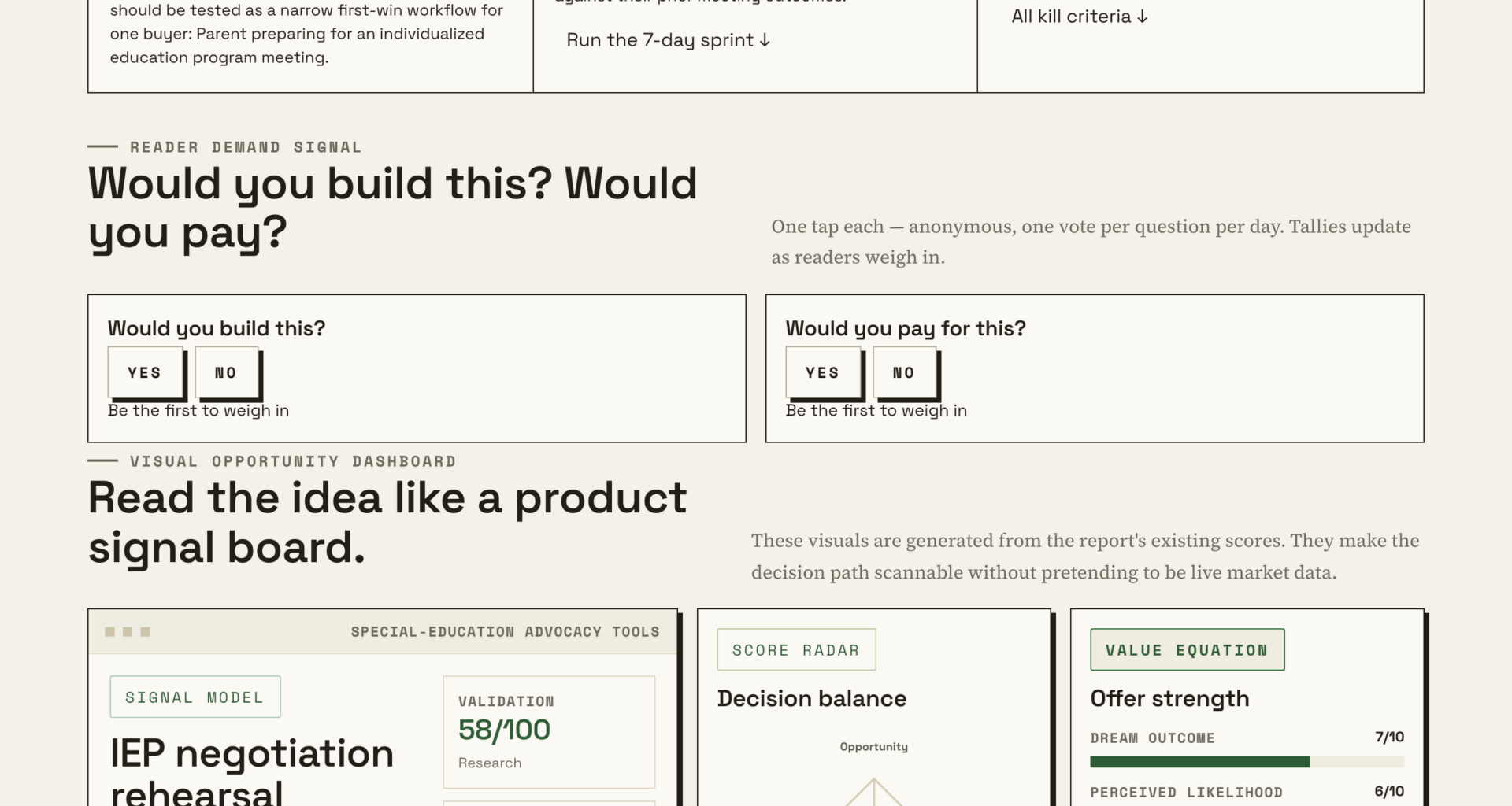

📊 Full opportunity report: How Do IEP Negotiation Simulators Work For Parents? on IdeaNavigator AI — validation score, market gap, and execution plan.

Get smart everyday buys delivered free with Prime
- Fast, free delivery on millions of items
- Prime Video, Amazon Music and more included
- Member-only deals all year
TL;DR
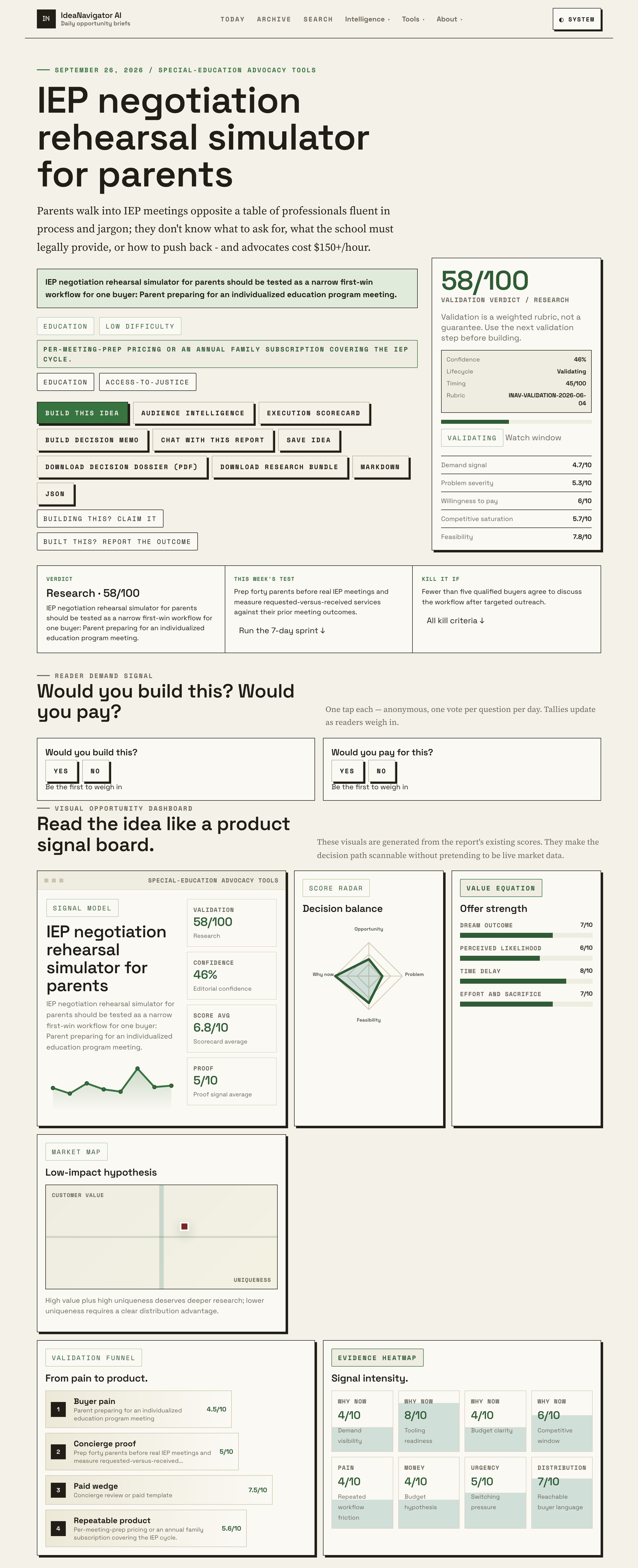
A proposed IEP negotiation simulator would help parents review education plans, prepare legally grounded requests and rehearse school meeting conversations with an AI role-play tool. The concept has not been shown to improve services; its proposed test is to prepare 40 parents and compare meeting outcomes with their prior results.
IdeaNavigator AI has proposed an IEP meeting rehearsal simulator that would help parents prepare requests and practice responses before meeting with school staff. The product is an early-stage concept, and there is no reported evidence yet that it improves the services students receive.
The proposed tool is aimed at a specific user: a parent preparing for an individualized education program meeting. Parents would upload a student’s current IEP and evaluation reports. The simulator would then explain the documents in plain language, produce a list of possible requests with legal grounding, and run a practice meeting that includes realistic pushback from school staff.
The stated problem is that parents may face a group of professionals who know the process and its terminology, while the parent may be unsure what to ask for or how to respond to disagreement. The concept also points to the cost of outside advocacy, citing rates of $150 or more per hour; no location, sample, or pricing survey is provided for that figure.
The proposed business model is either per-meeting preparation or an annual family subscription covering the IEP cycle. To test whether the tool is useful, the proposal calls for preparing 40 parents before real IEP meetings and comparing the services they request and receive with outcomes from their earlier meetings.
Preparing Parents for IEP Meetings
If developed and shown to help, the simulator could give parents a way to organize questions and practice describing the support they believe a student needs. Its role-play format is designed to let users rehearse replies to objections before the actual meeting, when discussions can affect the student’s education plan.
The concept may also offer a lower-cost preparation option for families who cannot pay for individual advocacy, though no product price or cost comparison is specified. Its practical value will depend on the accuracy of its explanations, the quality of its document interpretation, and whether practicing with it leads to better-informed participation or different services in actual meetings.
Top picks for "negotiation simulator work"
As an affiliate, we earn on qualifying purchases.
A Proposed Special Education Tool
An IEP is a plan for a student receiving special education services. The proposal focuses on the meeting where parents and school personnel discuss a student’s needs and the services and supports recorded in that plan. It frames the meeting as a setting where differences in familiarity with process and terminology can make preparation useful.
The proposal argues that language-model role-play is now capable of simulating a realistic meeting. That is a rationale for testing the idea, not evidence that a simulator can reliably interpret an individual student’s rights or produce accurate legal guidance. The description provides no product demonstration, evaluation study, launch date, or details about how the tool would check its answers.
Accuracy and Outcomes Remain Unknown
The simulator is presented as a product opportunity, not as a launched or evaluated service. It is not clear whether a working tool exists, when one might become available, or how parents would access it. The proposal also does not specify how the simulator would protect sensitive student records uploaded by families.
Its legal explanations and suggested requests have not been independently assessed in the information available. The planned test would compare parents’ requested and received services with their earlier meeting outcomes, but details such as how participants would be recruited, how outcomes would be measured, and how other changes would be accounted for are not provided. Even if services differ, that comparison alone may not establish that the simulator caused the difference.
The stated $150-plus hourly advocacy cost and rising special-education identification rates are presented without a cited dataset, date range, or geographic scope. The scale of the cost problem, the size of the potential market, and the claim that meetings are becoming more adversarial therefore remain unverified here.
Testing Before Wider Adoption
The next step described is to prepare 40 parents for real IEP meetings and record the services each parent requests and receives. The proposed comparison is with those parents’ prior meeting outcomes. No timetable, participating families, evaluation partner, or completed results have been announced in the available description.
Any assessment would need to clarify how outcomes are defined and whether the simulator’s explanations and recommendations are checked for accuracy. Until a working product is tested and results are reported, its ability to improve meeting preparation, change services, or reduce reliance on paid advocacy remains an open question.
Source: IdeaNavigator AI
Key Questions
What would the IEP simulator do?
The proposed tool would review an uploaded IEP and evaluation reports, explain them in plain language, suggest requests with legal grounding, and let a parent rehearse a meeting conversation.
Is the simulator available now?
The description outlines a product concept and a proposed test. It does not confirm that a working tool has launched or give an availability date.
Has it been shown to improve student services?
No results are reported. The proposal calls for preparing 40 parents and comparing the services they request and receive with their own prior meeting outcomes.
How might families pay for it?
Two possible models are described: a fee for each meeting preparation session or an annual subscription covering the IEP cycle. No prices are provided.
Source: IdeaNavigator AI
Fall Picks
fall essentials
As an affiliate, we earn on qualifying purchases.