
TL;DR

Get smart everyday buys delivered free with Prime
- Fast, free delivery on millions of items
- Prime Video, Amazon Music and more included
- Member-only deals all year
Nvidia lost an estimated $428 billion in market value over the two trading sessions ending Nov. 10, based on its share-price decline and reported share count. The drop reflected broader pressure on technology stocks as well as reported Nvidia-specific scrutiny; available sources do not quantify how much each factor contributed. Nvidia’s next quarterly results are scheduled for Nov. 17.
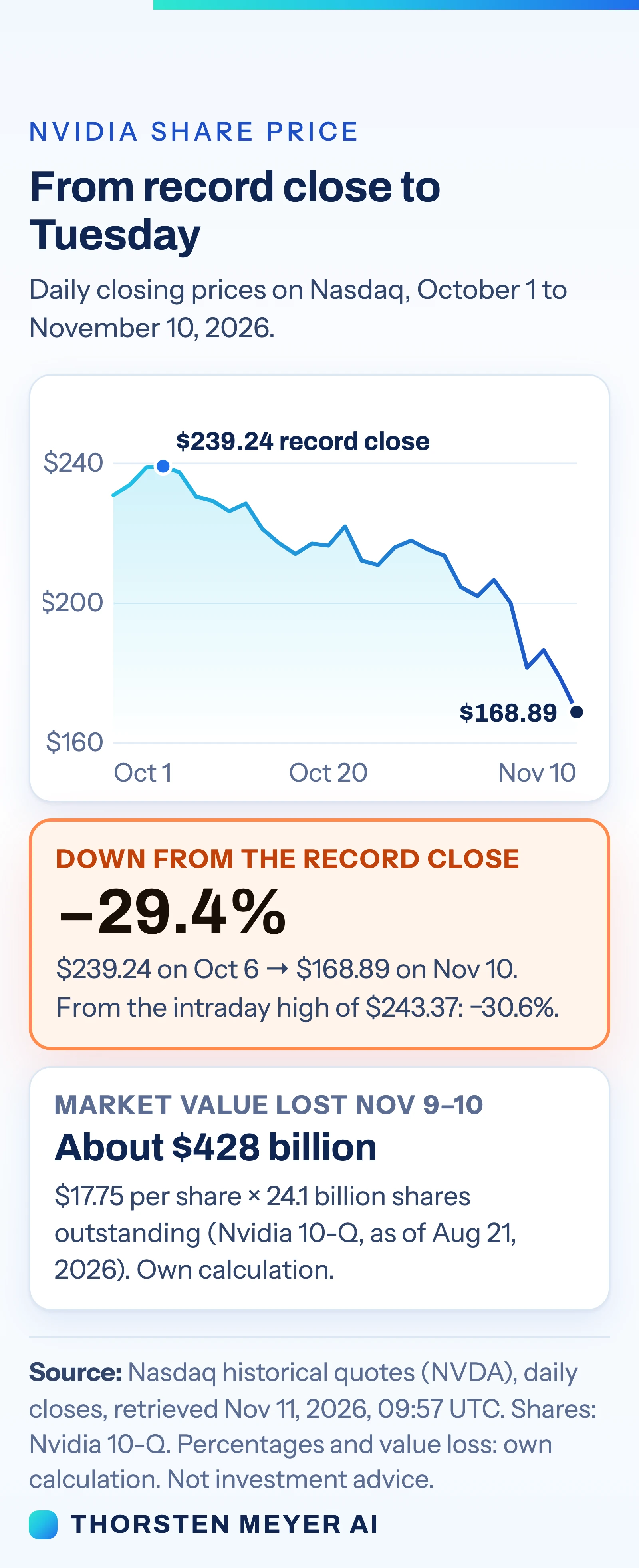
Nvidia shares fell 9.5% across Nov. 9 and 10, closing Tuesday at $168.89. A calculation using the company’s reported share count puts the resulting decline in market value at about $428 billion, as broader technology-market concerns coincided with reported scrutiny and legal developments involving the chipmaker.
The estimate uses Nasdaq closing prices: Nvidia fell from $186.64 on Nov. 6 to $168.89 on Nov. 10, a decrease of $17.75 per share. Nvidia’s latest quarterly filing listed 24.1 billion shares outstanding as of Aug. 21. Multiplying that share count by the price change gives an estimated loss of about $428 billion in market value. It is a calculation based on those figures, not a separate company-reported measure.
The decline extended a retreat from Nvidia’s Oct. 6 record close of $239.24. At Tuesday’s close, the stock was 29.4% below that closing record and 30.6% below the intraday high of $243.37 reached the same day. Applying the same share count to the decline from the record close produces an estimated market-value drop of about $1.7 trillion. These figures describe changes in market capitalization, not cash withdrawn from Nvidia.
The faster sell-off followed a steep Nov. 5 decline: shares fell 9.26% that day, rebounded 2.78% on Nov. 6, then fell 4.27% on Nov. 9 and 5.47% on Nov. 10. The Motley Fool described Nvidia as having lost 30% of its value from its all-time high. All prices and calculated comparisons here use closing prices through Nov. 10.
Nvidia’s Weight in Market Indexes
The move matters beyond Nvidia because the company has a large presence in major stock-market indexes. As of Nov. 9, Nvidia represented 6.64% of SPY, an S&P 500 tracker, and 7.10% of QQQ, a Nasdaq-100 tracker. A sharp change in one heavily weighted stock can affect the funds and indexes that hold it.
CNBC reported that Nvidia dragged down the three major averages on Tuesday. Reuters also reported that Microsoft briefly overtook Nvidia as the world’s second-most valuable company during the session; AFP said Nvidia had returned to second place behind Apple by the close. The valuation ranking shifted intraday, while Nvidia’s closing price and the broader market declines provide the clearest measures of the day’s outcome.
For businesses and users, the market move is a signal of investor uncertainty around the companies and spending plans behind the AI boom. It does not by itself establish that demand for Nvidia chips has fallen, or that customers will change their plans. The share-price data show a repricing; they do not settle the outlook for AI infrastructure or Nvidia’s future results.
Products Worth Considering

Apple MacBook Air 13.6-inch Laptop with M5 Chip, 16GB Memory, 512GB SSD, Midnight

Samsung 32-inch Odyssey OLED G8 (G80SH) 4K Gaming Monitor

Logitech MX Master 4 Ergonomic Wireless Mouse with Haptic Feedback, Graphite
As an affiliate, we earn on qualifying purchases.
From Record High to Sell-Off
Nvidia closed at $239.24 on Oct. 6, near its then-record level. Yahoo Finance reported that the shares settled just below an all-time intraday high and that Nvidia’s intraday market value reached $5.84 trillion. By Nov. 4, the stock had closed at $200.13. The subsequent moves were abrupt: a 9.26% drop on Nov. 5, a partial recovery the next day, and further losses on Nov. 9 and 10.
Reporting describes pressure on the broader AI trade as one part of the decline. AFP linked heavy technology-sector selling to fears of a slower data-center buildout after the U.S. midterm elections. The Motley Fool said investors were concerned that the incoming Congress might be more hostile to AI development and pointed to announced plans by some incoming governors for data-center construction moratoriums. Those are reported market concerns and political proposals; the source material does not establish that they have changed Nvidia’s sales or customer commitments.
On Nov. 10, AFP linked a market-wide decline to October inflation data that slowed less than expected and increased expectations of Federal Reserve rate hikes. CNBC reported that the consumer price index rose 0.4% in October, compared with economists’ expected 0.3%, while the Nasdaq fell 0.7%. Reuters also cited uncertainty about the AI outlook. Higher borrowing costs can affect capital-intensive projects, but the reporting does not quantify any effect on Nvidia’s business.
““has lost 30% of its value””
— The Motley Fool
What the Sell-Off Does Not Show
Available reporting does not establish how much of Nvidia’s decline came from inflation and interest-rate expectations, concerns about AI data-center spending, or developments specific to the company. No source cited here assigns a precise share of the price move to each factor. The $428 billion estimate is an arithmetic calculation using closing prices and a share count reported as of Aug. 21; it is not a direct measure of investor losses or company cash.
The source material also cites a board investigation announced Nov. 8, a proposed shareholder class action filed Nov. 9 and scrutiny of a Nvidia customer over export controls. The details and implications of those developments are not fully established in the material provided. It remains unclear whether they will affect Nvidia’s operations, customer relationships, or financial outlook.
The reported concern about slower data-center construction is likewise a market interpretation. The material does not show that a slowdown has occurred or specify whether proposed construction limits will take effect. Nvidia’s stock performance alone cannot answer those questions.
Nvidia’s November 17 Results
Nvidia is scheduled to report its third-quarter results on Nov. 17. The results and any company comments may give investors more information about recent demand, customer spending and the outlook for data-center products. The source material does not specify what guidance the company will provide.
Until then, the Nov. 10 close is the latest market figure covered here. Investors will also be watching for further reporting on the board investigation, the proposed shareholder lawsuit and the export-control scrutiny involving a customer. Whether those issues have measurable business effects remains unresolved in the information available.
Key Questions
How much market value did Nvidia lose over the two trading sessions?
The estimate is about $428 billion, calculated from the decline from $186.64 at the Nov. 6 close to $168.89 at the Nov. 10 close, multiplied by Nvidia’s reported 24.1 billion shares outstanding as of Aug. 21.
How far was Nvidia below its record close?
At the Nov. 10 close, Nvidia was 29.4% below its Oct. 6 record close of $239.24. It was 30.6% below the intraday high of $243.37 reached that day.
What factors were reported behind the decline?
Sources cited broader technology-market concerns about AI data-center spending and higher interest-rate expectations, alongside Nvidia-specific developments including a board investigation, a proposed shareholder lawsuit and scrutiny of a customer over export controls. The available reporting does not quantify each factor’s contribution.
When does Nvidia report its next quarterly results?
Nvidia’s third-quarter results are scheduled for Nov. 17, 2026. The source material does not state what guidance or additional details the company will release.
Source: Thorsten Meyer AI