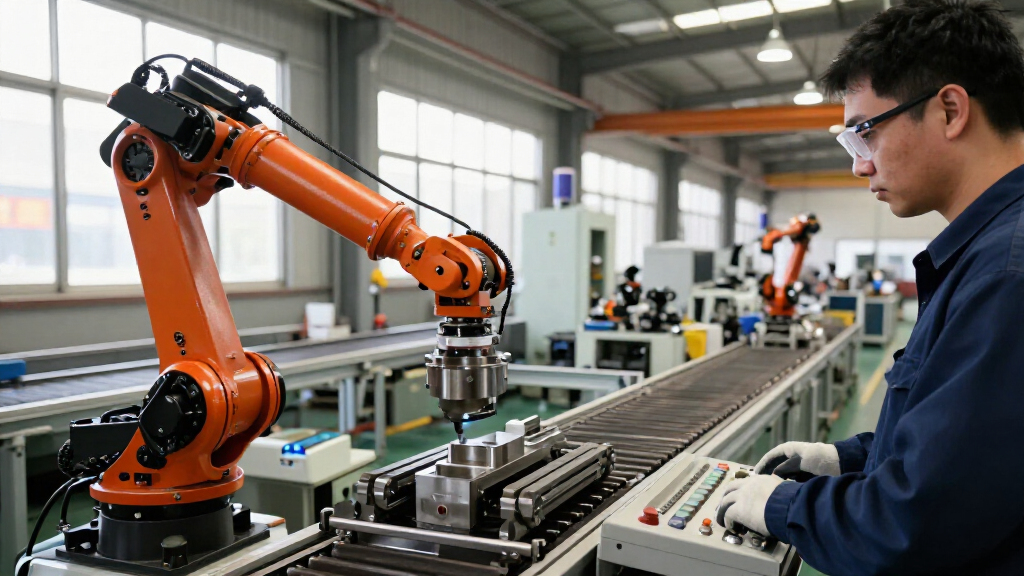

🔍 Read the full analysis: A Practical Look At AI Robots In Factories on ThorstenMeyerAI.com

Get smart everyday buys delivered free with Prime
- Fast, free delivery on millions of items
- Prime Video, Amazon Music and more included
- Member-only deals all year
TL;DR
The International Federation of Robotics reported 5 million industrial robots operating worldwide in 2025, with China accounting for 59% of new installations. Research cited by ThorstenMeyerAI.com finds robots displaced some U.S. workers, while Germany’s job losses in manufacturing were largely offset by service-sector gains. The evidence does not show one uniform effect on employment.
Industrial robots reached 5 million in operation worldwide in 2025, according to figures from the International Federation of Robotics (IFR) cited in a November 24 report by ThorstenMeyerAI.com. The report’s central finding is that robots have displaced some workers, particularly in U.S. manufacturing, but their broader employment effect varies by country and sector.
The IFR’s World Robotics report, published September 24, 2026, counted more than 600,000 new installations in 2025, a 9% rise in the number of robots operating globally from the prior year and more than double the stock recorded seven years earlier. China installed 354,000 robots, or 59% of the global total. The United States installed almost 38,500, while Japan installed 36,219, South Korea 30,000 and Germany fewer than 25,000, according to the source material.
The report traces industrial robotics to Unimate, which began work at a General Motors plant in Trenton, New Jersey, in 1961. It unloaded a die-casting press, handling hot metal parts. Robots later took on welding and other physically demanding tasks. At GM’s Lordstown plant in 1969, more than 90% of body welding was automated, compared with 20% to 40% at traditional plants, according to the IFR figures cited by ThorstenMeyerAI.com.
On employment, the article cites a study by economists Daron Acemoglu and Pascual Restrepo, published in 2020. Their estimate for the United States was that each additional industrial robot from 1990 to 2007 displaced about 3.3 workers across the economy, for an estimated total of roughly 400,000 jobs. The article contrasts this with Germany, where it says factory employment fell by almost two jobs per additional robot while service-sector employment rose by about the same amount. These are study estimates, not a count of every worker affected or a forecast for later years.
Infographic 01 · Five million robots
Where the robots work
Sixty-five years after the first Unimate, five million industrial robots work in the world's factories. South Korea has by far the most per worker.
Robots per 10,000 employees in manufacturing · 2024
Where the new robots went · 2025
- China: 354,000 installed, 59% of the world total.
- United States: almost 38,500 (+12%), again the second-largest market.
- Japan 36,219 (−19%) · South Korea 30,000 · Germany fewer than 25,000 (−8%), Europe’s largest market.
Robot density = operational industrial robots per 10,000 employees in manufacturing. China (166 in 2024) is not compared here: the IFR switched to updated Chinese labour data in 2026, which changed the denominator.
Sources: IFR, robot density press release, 8 Apr 2026 (data 2024); IFR, World Robotics 2026 press release, 24 Sep 2026.
Powered by Thorsten Meyer AI
Robot Growth and Uneven Job Effects
The figures matter because automation is expanding at a scale large enough to shape factory investment and the types of work available. More robots can reduce demand for some production jobs, especially tasks involving repetitive handling, welding or exposure to heat and other hazards. At the same time, the examples in the report show that a change in factory employment does not automatically equal the same change in total employment.
The difference between the U.S. and German estimates highlights why national totals can obscure who bears the cost. Workers who lose jobs, workers who remain, and younger people who never enter a factory job may experience automation differently. The figures presented do not establish that service jobs are available to the same people, in the same places or at comparable pay. Nor do they show that every robot installation removes a position: the effect depends on the task, industry, time period and wider economy.
The robot counts also offer a measure of industrial change, not a direct measure of productivity or worker welfare. A large number of machines may indicate that manufacturers are investing in automation, but the count alone cannot show whether jobs were eliminated, changed or created elsewhere. Readers should treat the employment estimates as evidence about particular periods and settings, rather than a universal rule.
Products Worth Considering

FLEXISPOT Adjustable Bed Base with Massage and 12-Inch Gel Memory Foam Mattress

LG 27-Inch QHD 300Hz IPS Gaming Monitor with USB-C

Apple MacBook Air 15-inch Laptop with M5 Chip, 16GB Memory, 512GB SSD, and Liquid Retina Display (Midnight)
As an affiliate, we earn on qualifying purchases.
From Unimate to Global Installations
The report’s historical account begins with inventor George C. Devol’s 1954 patent application for a programmed machine to transfer articles. Devol and entrepreneur Joseph Engelberger formed Unimation, and the company’s Unimate went to GM’s Trenton plant. The IFR and The Henry Ford museum identify the machine as the first industrial robot used on a production line. Its initial assignment—unloading hot castings—illustrates how factories first applied robots to work that was heavy, hazardous or difficult to staff.
Robots moved into car-body welding in the late 1960s. Japan’s Kawasaki signed a licence agreement with Unimation in 1968 and completed a Kawasaki-Unimate robot the following year, according to Kawasaki’s company history. The source says factories there faced shortages of workers for jobs described by the Japanese term “3K”: hard, dirty and dangerous. European manufacturers also developed industrial robots in the 1970s.
Robot density provides another way to compare adoption, because it measures machines against manufacturing employment rather than counting installations alone. The IFR’s latest figures cited in the report, covering 2024, put South Korea at 1,220 robots per 10,000 manufacturing employees, followed by Singapore at 818, Germany at 449 and Japan at 446. The United States ranked eighth at 307; the global average was 132. These figures measure robot density, not the number of jobs robots have replaced.
“Each additional industrial robot replaced about 3.3 workers across the U.S. economy from 1990 to 2007.”
— Daron Acemoglu and Pascual Restrepo, as summarized in the report
Limits of the Employment Estimates
The source material does not provide the full methods, confidence ranges or detailed breakdowns behind the employment estimates. The 3.3-worker estimate covers U.S. data from 1990 to 2007; it cannot, by itself, establish the effect of robots on employment in 2025 or in other countries. The Germany comparison is also presented in summary form, without enough detail here to assess differences among industries, worker groups or regions.
It is not clear from the cited figures how many displaced workers found other jobs, how their wages changed or whether service-sector gains went to people who had lost manufacturing work. The robot installation totals likewise do not identify whether machines replaced workers, supported expanded production or changed tasks within existing jobs. The effect on individual workers remains distinct from the net change in national employment, and the source does not quantify that distinction.
Track Jobs Alongside Robot Counts
The immediate next step for readers and policymakers is to compare future IFR installation and density data with employment, wages and job-transition measures. The source reports that the IFR published its 2025 operating-stock figures on September 24, 2026, and its latest density figures cover 2024. Later releases may provide updated comparisons, but the material cited here does not specify when new employment research will appear.
Until comparable studies cover more recent years and a wider range of countries, the strongest supported conclusion remains limited: factory automation can displace workers in some settings, while employment outcomes differ across economies and sectors. Robot totals show the pace of adoption; they do not settle what happens to workers next.
Key Questions
How many industrial robots were operating worldwide in 2025?
The International Federation of Robotics counted 5 million industrial robots in operation worldwide in 2025. It reported more than 600,000 new installations that year.
Which country installed the most factory robots in 2025?
China installed 354,000 robots, or 59% of the global total, according to the IFR figures cited by ThorstenMeyerAI.com.
Did factory robots reduce employment?
Research cited in the report estimates that robots displaced workers in the United States from 1990 to 2007. The article contrasts that result with Germany, where reported manufacturing job losses were roughly offset by service-sector gains. The estimates do not establish one effect for every country or period.
What was Unimate’s job at GM?
Unimate began operating at a GM plant in Trenton, New Jersey, in 1961, unloading a die-casting press and stacking hot metal parts. The IFR and The Henry Ford museum identify it as the first industrial robot on a production line.
Does robot density show how many jobs have been replaced?
No. Robot density counts industrial robots per 10,000 manufacturing employees. It compares the prevalence of robots across economies but does not measure how many jobs were eliminated or created.
Source: ThorstenMeyerAI.com