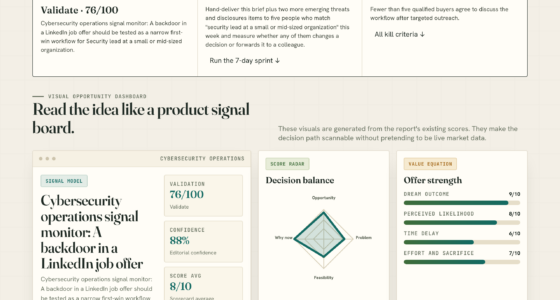
📊 Full opportunity report: Agent Authorization Explained: Approvals, Actions, And Audits on IdeaNavigator AI — validation score, market gap, and execution plan.

Get smart everyday buys delivered free with Prime
- Fast, free delivery on millions of items
- Prime Video, Amazon Music and more included
- Member-only deals all year
TL;DR

A proposed security workflow would place a proxy between an autonomous AI agent and a high-risk API, requiring a signed, single-use token for each exact action. The idea is a product proposal, not a report of a deployed system or measured results; a one-month test around a refund or deletion endpoint is suggested.
IdeaNavigator AI has outlined a proposed authorization workflow for autonomous AI agents that take actions through APIs: a proxy would require a signed, single-use token describing the precise action and arguments before allowing access to a high-risk endpoint. The proposal, published on IdeaNavigator AI’s website, targets platform engineers and is intended to limit the risk of agents acting on broad, standing credentials, while recording approvals and denials for later review.
In its proposal, IdeaNavigator AI describes a proxy that would sit between an agent and one high-risk API. Before an action could proceed, the agent would request a token specifying the operation and its arguments. The proxy would apply policy rules, then grant or deny the request. The proposal says both outcomes would be logged for audit, creating a record tied to the requested action rather than relying only on broad access permissions.
IdeaNavigator AI frames the problem as teams giving agents broad API tokens that can carry out consequential tasks. Its examples include sending refunds, deleting records and emailing customers—actions that could go wrong after a prompt-injection attempt or a reasoning error. The proposal does not report a specific incident or quantify how often such failures occur.
As an initial test, IdeaNavigator AI proposes wrapping a single team’s refund or delete endpoint for one month. The team would require per-action tokens and compare blocked unsafe actions and added latency with an unscoped baseline. The proposal also suggests usage-based charges per authorized action, alongside a platform fee for policy controls and an audit dashboard; it provides no pricing or customer adoption figures.
Security workflow proposal · IdeaNavigator AI
Agent Authorization Explained: Approvals, Actions, and Audits
A proposed proxy would gate high-risk API calls with signed, single-use tokens tied to the exact action and its arguments. The workflow is a product concept with a suggested pilot, not a deployed or measured system.
01 / Proposed control path
From request to audit trail
A narrow proxy would sit between an autonomous agent and one consequential API endpoint, checking each requested action before it proceeds.
Agent requests
Names the operation and supplies its arguments.
Token is signed
A token describes that precise action for one use.
Proxy checks policy
Rules are applied before the endpoint is reached.
Allow or deny
Only an allowed request proceeds to the API.
Decision is logged
Approval and denial records support later review.
02 / Why it matters
Less standing access, more action-level control
The proposal focuses on agents that can invoke tools autonomously, especially when a request could move money, alter records, or contact customers.
Broad permission persists
Scopes can limit categories of activity while still granting access across many calls. The proposal argues this may leave room for consequential actions beyond the agent’s immediate task.
- One credential can cover repeated operations
- Prompt injection or reasoning errors are possible risks
- Access may be broader than a single action needs
Permission is tied to the call
A fresh, single-use token would describe an exact operation and its arguments before a high-risk request reaches the API.
- Policy check for each token request
- Allow and deny decisions recorded
- Potentially clearer review of agent behavior
03 / Scope and open questions
A focused proposal, with key details unresolved
The initial design targets one endpoint. It does not claim to replace an organization’s full authorization system or prevent every unsafe action.
High-impact actions
Examples include sending refunds, deleting records, and emailing customers—operations where mistakes could have real consequences.
Latency and false denials
A proxy could slow legitimate workflows or block valid requests. Logging a decision alone does not show that every unsafe action would be caught.
Implementation choices
Token expiry, policy language, approvers, identity integration, replay protection, exceptions, and emergency actions remain open questions.
04 / Suggested validation
Measure the protection and the added friction
IdeaNavigator AI proposes a month-long test for one team and one consequential endpoint, such as refunds or record deletion.
MEASURES PROPOSED · RESULTS NOT REPORTED
05 / Key questions
What the proposal does—and does not—establish
What is per-action authorization?
A proposed control requiring a single-use token for a specific operation and its arguments before a high-risk API call is allowed.
Has it been tested in production?
No deployment or test results are reported. The one-month endpoint trial is a suggestion, and no start date or participating team is announced.
What would the pilot measure?
Blocked unsafe actions and added latency, compared with an unscoped baseline. No measurements are available yet.
What is the commercial model?
The proposal anticipates per-action usage charges plus a platform fee for policy controls and an audit dashboard, with no pricing or adoption figures provided.
Tighter Controls on Agent Actions
The proposal addresses a practical security question as software agents are designed to use tools and take actions: how much permission should an agent have at the moment it acts? In its proposal, IdeaNavigator AI contrasts standing credentials, which can authorize many operations, with a per-action gate that could check each request against specific rules. That distinction may matter most for endpoints that move money, alter records or contact customers.
IdeaNavigator AI says a record of both approved and denied requests could help platform and security teams investigate how an agent behaved and whether controls blocked a risky operation. The benefits remain untested, however. A proxy could add latency or interfere with legitimate workflows, and logging alone does not establish that every unsafe action would be caught. The proposed month-long trial is presented as a way to measure those trade-offs, not as proof that the approach works.
Products Worth Considering

Dell UltraSharp 32 U3226QER 4K Thunderbolt Hub Monitor

Apple Mac mini Desktop Computer with M5 Pro Chip (2026)

Logitech MX Keys S Wireless Keyboard, Graphite
As an affiliate, we earn on qualifying purchases.
From Standing Tokens to Single Actions
Many API authorization systems use scopes to limit what an application or user can do. IdeaNavigator AI argues in its proposal that scopes can still grant standing access: they define permitted categories of activity but do not necessarily require fresh approval tied to every action and its arguments. The proposal presents this as a concern for agents that can select and invoke tools autonomously.
IdeaNavigator AI describes a narrow first deployment, not a replacement for an organization’s entire authorization system. It would cover one high-risk API endpoint, apply policies to requests, and issue single-use tokens only for allowed actions. The proposal does not specify token expiration details, the policy language, who would approve requests, or how the proxy would connect to existing identity and audit systems.
Pilot Results and Design Details
IdeaNavigator AI’s proposal describes no working product, live deployment or test outcome. It is not clear whether a team has agreed to run the proposed one-month trial, what baseline measurements would be used, or what level of added latency would be acceptable. The proposal provides no figures for blocked actions, false denials, security incidents or operating costs.
Key implementation questions remain open: how the proxy would verify the agent and token signature; how policies would distinguish safe from unsafe requests; whether a token could be replayed or altered; and how exceptions and emergency actions would be handled. IdeaNavigator AI identifies prompt injection and reasoning errors as possible risks but does not claim that per-action authorization would prevent every such failure.
A One-Month Endpoint Test
IdeaNavigator AI proposes selecting one team and one consequential endpoint, such as refunds or record deletion, and routing requests through the proxy for a month. The team would compare blocked unsafe actions and added latency against its unscoped baseline. The proposal says results could help determine whether the extra approval step offers useful protection without causing unacceptable delays.
No start date, participating team or follow-up report has been announced. Until a pilot produces measurements, the workflow remains a product concept with a suggested validation plan, rather than a demonstrated security control. IdeaNavigator AI also anticipates a policy and audit dashboard with per-action usage pricing, but provides no launch schedule or commercial terms.
Source: IdeaNavigator AI proposal
Key Questions
What is per-action authorization for an AI agent?
In IdeaNavigator AI’s proposal, it is a control that asks an agent to obtain a single-use token for a specific operation and its arguments before a high-risk API call is allowed.
How would the proposed proxy work?
IdeaNavigator AI’s proposed proxy would sit between the agent and an API, apply policy rules to each token request, allow or deny the action, and log the decision for later review.
Has the system been tested in production?
IdeaNavigator AI reports no deployment or test results. Its proposal suggests a one-month trial covering one team’s refund or deletion endpoint.
What would the proposed pilot measure?
The proposal says the pilot would track unsafe actions blocked and the latency added by the proxy, comparing those results with an unscoped baseline. No measurements are available yet.
Source: IdeaNavigator AI