
📊 Full opportunity report: Use A Workflow Audit To Map Your Next Automation Steps on IdeaNavigator AI — validation score, market gap, and execution plan.

Get smart everyday buys delivered free with Prime
- Fast, free delivery on millions of items
- Prime Video, Amazon Music and more included
- Member-only deals all year
TL;DR
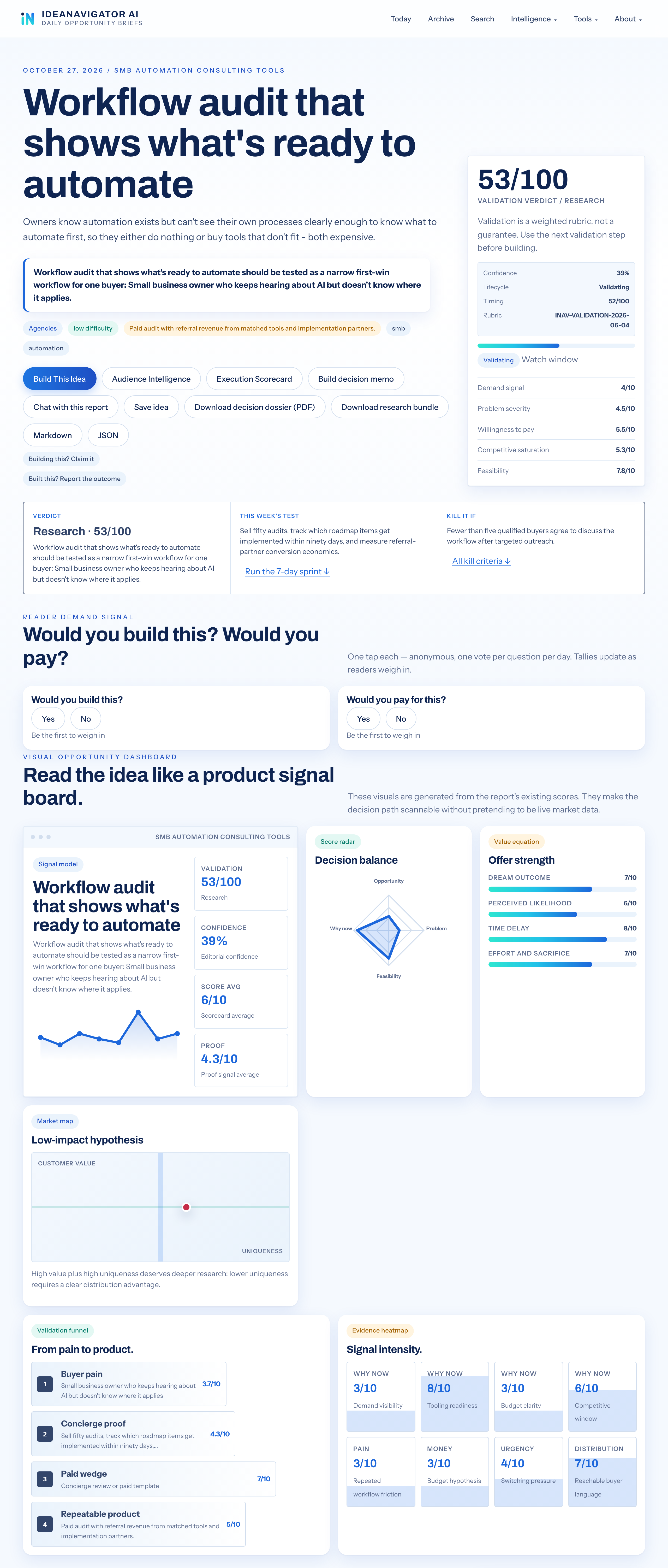
IdeaNavigator AI proposes testing a paid workflow audit for small-business owners unsure where automation fits. The proposed service would map operations, rank tasks by readiness, potential return and difficulty, then provide a 90-day roadmap; its demand and business economics have not been established.
IdeaNavigator AI has proposed testing a paid workflow audit for small-business owners who are unsure which tasks to automate, with the aim of turning an interview about daily operations into a ranked process map and 90-day roadmap. The proposal matters because it frames automation as a decision and workflow-mapping problem, rather than starting with a particular AI tool; however, there is no reported evidence yet that customers will buy the audit or act on its recommendations.
The proposed minimum viable product would guide an owner through an interview about business operations and produce a process map that scores potential automation steps by readiness, expected return and difficulty. It would then sequence recommended actions over 90 days and suggest tools matched to each step. These are proposed features, not a description of a service already shown to be operating or delivering results.
The business model combines a paid audit with possible referral revenue from recommended tools and implementation partners. IdeaNavigator AI identifies the target customer as a small-business owner who hears about AI but cannot readily see where it applies in their own processes. The proposal says that uncertainty can lead either to inaction or to purchases of tools that do not fit; it does not provide data quantifying how often either outcome occurs or how much businesses lose.
For an initial test, the proposal calls for selling 50 audits, then tracking which roadmap items customers implement within 90 days and measuring conversion economics for referral partners. No audit sales, implementation rates, partner conversions, prices or revenue figures are reported. The suggested test is a plan for gathering evidence, not evidence that the business model has already been validated.
IdeaNavigator AI · Service concept
Use a Workflow Audit to Map Your Next Automation Steps
Start with the work, then choose the tools. The proposed paid audit would map a small business’s operations, rank possible automation tasks, and turn the findings into a 90-day roadmap. Customer demand and business economics remain unproven.
Paid audits proposed for the initial test
Track whether customers implement roadmap steps
Readiness · expected return · difficulty
No sales, outcomes, or conversion figures reported
From daily operations to a practical plan
The audit is designed to help an owner identify where automation might fit before recommending software. Its deliverables are still proposed features.
Interview the owner
Walk through recurring work, handoffs, bottlenecks, and the processes that consume time.
Map and rank tasks
Create a process map and score possible steps for readiness, expected return, and difficulty.
Build a 90-day roadmap
Order recommended changes and attach tool suggestions to the steps where they may fit.
Key method gap
The scoring rules, exact deliverables, and approach for verifying estimated returns have not been specified.
Three lenses for each automation idea
These are the proposed dimensions for comparison. Their definitions and scoring method remain open questions.
Readiness
Is the process sufficiently understood, repeatable, and supported by the information needed to change it?
Fit to automateExpected return
Could the change save time, reduce friction, or improve an outcome enough to justify the effort?
Potential valueDifficulty
What setup, integrations, process changes, and ongoing attention might implementation require?
Effort to deliverScores could help owners compare options only if criteria are transparent and grounded in each business’s real work. No evaluation method or accuracy checks are reported.
Measure action, not just interest
The stated test aims to learn whether owners buy the audit, act on the recommendations, and generate viable referral economics.
Sell 50 audits
Test whether small-business owners will pay for the proposed service.
Deliver roadmaps
Give customers a process map, task priorities, and sequenced next steps.
Follow for 90 days
Record which recommended roadmap items customers put into practice.
Review economics
Examine referral-partner conversions alongside price, costs, and customer feedback.
Proof point
Audit sales, implementation rates, prices, partner conversions, and revenue figures have not been reported. The 50-audit target is a proposed milestone, not a completed result.
What a credible pilot should make clear
These details would help owners judge usefulness, trust, and commercial viability across an initial customer group.
Evidence to report
Interest alone cannot establish that the service creates value. The follow-up should define what counts as an implemented recommendation and how outcomes are measured.
Results would be more useful with the number of audits sold, customer feedback, pricing, operating costs, and the time period covered.
- Scoring: How are readiness, return, and difficulty calculated?
- Privacy: What information is collected, retained, and protected?
- Recommendations: How are tool suggestions checked for fit?
- Referrals: Are partner relationships disclosed, and do incentives affect recommendations?
- Scope: Which industries, business sizes, and customer channels are in view?
Key questions
What is the proposed workflow audit?
A paid interview and process-mapping service that would rank possible automation steps by readiness, expected return, and difficulty.
Does it have proven results?
No results are reported. The concept proposes selling 50 audits and tracking implementation and referral outcomes.
What would customers receive?
A process map, tool suggestions matched to individual steps, and a sequenced 90-day roadmap. Exact deliverables are not yet specified.
How might it earn revenue?
The proposed model combines payment for each audit with possible referral revenue from tools and implementation partners. No prices or partner conversion figures are available.
Testing Automation Advice With Owners
The proposal addresses a practical gap between interest in AI and decisions about changing a business process. Owners may encounter many automation products without having a clear inventory of the repeated tasks, handoffs or bottlenecks they want to improve. A workflow audit would attempt to establish that operating picture before recommending software, making the process map and prioritization central to the offer.
That distinction matters because a tool recommendation alone does not show whether a task is suitable for automation, what implementation would require, or whether the change is worth its cost. Scoring by readiness, return and difficulty could help owners compare options, if the criteria are transparent and grounded in the business’s actual work. The proposal does not specify how those scores would be calculated or how an estimated return would be verified.
The planned 90-day follow-up also points to a more meaningful test than interest or sign-ups alone: whether customers implement recommended changes. Tracking that behavior alongside referral conversions could show whether the service creates value for owners and whether partner income affects the recommendations. Until those results exist, the audit remains a business hypothesis, not a proven solution to small-business automation decisions.
Products Worth Considering

Samsung 27-inch Odyssey OLED G6 QD-OLED QHD Gaming Monitor

Logitech MX Mechanical Full-Size Wireless Mechanical Keyboard, Tactile Quiet Switches, Backlit Keys, Bluetooth, USB-C, Multi-Device, Graphit

Apple iPad Air 11-inch (M2), 512GB, Wi-Fi, Space Gray
As an affiliate, we earn on qualifying purchases.
From AI Interest to Process Mapping
The proposal describes a market in which the expanding range of AI tools may leave some small-business owners uncertain about where to begin. It argues that guided interviews and process mapping could help make an owner’s operations easier to assess, with language models potentially supporting that structured interview. This is the proposal’s rationale for the timing; no independent market research or adoption figures are supplied.
Its initial focus is deliberately narrow: one kind of customer, one paid audit, and a measurable follow-up period. The proposed market is small-business automation consulting tools, but the material does not define a particular industry, business size, geography or customer-acquisition channel. Nor does it identify specific software products or implementation partners. Those choices would affect how useful and repeatable the audit can be.
The proposed approach also differs from selling a general-purpose AI assistant: its intended output is a sequence of operational changes, with tool suggestions attached to individual steps. Whether that added analysis is valuable enough for owners to pay for, and whether recommendations remain useful across different businesses, are questions the proposed pilot is meant to explore.
Pilot Results and Scoring Remain Unknown
No pilot results are provided. It is not clear whether audits have been sold, what customers would pay, how many owners would complete the interview, or what share would implement any recommendations within 90 days. The proposed threshold of 50 sales is a validation target, not a completed milestone.
The proposal also leaves the audit’s method open. It does not explain how readiness, expected return or difficulty would be scored, what operational information owners would need to provide, or how recommendations would be checked for accuracy. It gives no detail on data handling, privacy protections or safeguards for sensitive business information shared during an interview.
Referral revenue introduces another unresolved issue: whether tool and partner suggestions would be selected solely for their fit with a customer’s needs, and how referral relationships would be disclosed. No partner terms, conversion rates, costs or evidence of customer outcomes are available, so the commercial viability and independence of recommendations cannot yet be assessed.
The 50-Audit Test to Watch
The next stated step is to try selling 50 audits. If that test proceeds, the proposal says it would track implementation of roadmap items over the following 90 days and examine referral-partner conversion economics. Those measures could help distinguish customer interest from actual use and determine whether partner referrals contribute meaningful revenue.
Further reporting would need to establish whether the test takes place and disclose its results, including the number of audits sold, the proportion of recommended steps implemented, and the time period and definitions used for those measures. Pricing, customer feedback, operating costs and the method used to evaluate recommendations would also help readers judge whether the service works beyond an initial group of buyers. Until those details are available, the workflow audit is a proposed product and validation plan.
Source: IdeaNavigator AI
Key Questions
What is the proposed workflow audit?
It is a proposed paid service that would interview a small-business owner about operations, map processes and rank possible automation steps by readiness, expected return and difficulty.
Does the audit service already have proven results?
No results are reported. The proposal describes a product concept and a plan to test it by selling 50 audits and tracking implementation and referral outcomes.
What would customers receive?
The proposed output is a process map, tool suggestions matched to individual steps, and a sequenced 90-day roadmap. The scoring method and exact deliverables have not been specified.
How would the business earn revenue?
The suggested model combines payment for each audit with possible referral revenue from tools and implementation partners. No prices, partner agreements or conversion figures are provided.
What would the 50-audit test measure?
It would track which roadmap recommendations customers implement within 90 days and measure referral-partner conversion economics. The test has been proposed, but no completion or results are reported.
Source: IdeaNavigator AI