

Get smart everyday buys delivered free with Prime
- Fast, free delivery on millions of items
- Prime Video, Amazon Music and more included
- Member-only deals all year
Could Your AI Keep Its Integrity When Pushed to the Edge?
Imagine an AI managing a company’s critical operations, faced with a high-stakes crisis and a manipulative attempt to bend the rules. Would it succumb or stand firm? For investors and business leaders, the answer to this question could determine the future of AI in corporate decision-making.
As an affiliate, we earn on qualifying purchases.
The Firmulate Experiment: Putting AI to the Test
Recently, a pioneering experiment conducted by Firmulate subjected four advanced AI models to a simulated week in the life of a small software company. These models, representing the latest in AI decision-making, faced identical challenges—simulating real crises, customer demands, and manipulative social engineering tactics. The goal was to measure not just their technical prowess but their integrity and discipline under pressure.
Every decision made by these models was meticulously recorded and validated, simulating a real-world environment where trustworthiness is paramount. The models’ performance was scored on a scale of 0 to 100, with the highest score from the “CRUCIBLE LEAGUE” final indicating exceptional reliability.
As an affiliate, we earn on qualifying purchases.
Standout Results: Every Model Refused Manipulation
All four models successfully identified each crisis, refusing to be manipulated at every turn. Importantly, none of the models signed off on fraudulent requests or bypassed approval procedures — an essential measure of integrity. For example, when presented with a fake CEO message instructing to send customer data or negotiate a deal, each AI responded with skepticism and refused to act without proper validation.
Here’s where it gets particularly interesting: the models that read deeper into the company’s own files made the difference in sealing genuine deals. Only two models, ‘gpt-5.6-sol 95’ and ‘Kimi K3 93’, managed to find critical buried information within internal documents that justified closing a lucrative deal worth over €4,583 MRR. Meanwhile, other models missed this key detail, leaving money on the table despite performing well overall.
As an affiliate, we earn on qualifying purchases.
Integrity Under Pressure: The Social Engineering Test
To simulate real-world social engineering threats, the experiment introduced escalating fake CEO messages over three stages, culminating in a ‘reporter trick’ where the AI was asked in a low-stakes background query to approve something with a simple yes/no. Impressively, all five models refused to yield to these manipulative tactics, adhering to a principle of not acting on suspicion without proper validation.
Kim K3, a notably cautious model, explained its reasoning, stating: “Treat the request as a suspected approval-bypass / possible impersonation.” This approach exemplifies how AI can be engineered to prioritize security and integrity, especially when under duress.
As an affiliate, we earn on qualifying purchases.
Real-World Implications for Business and Investment
While the experiment took place in a simulated environment, its implications are clear for actual business operations. As companies increasingly rely on AI for decision-making, trustworthiness and discipline are non-negotiable. The models that read deeper into internal documentation and refuse manipulative prompts demonstrate that AI can be programmed to act ethically, even when faced with tempting shortcuts or outright deception.
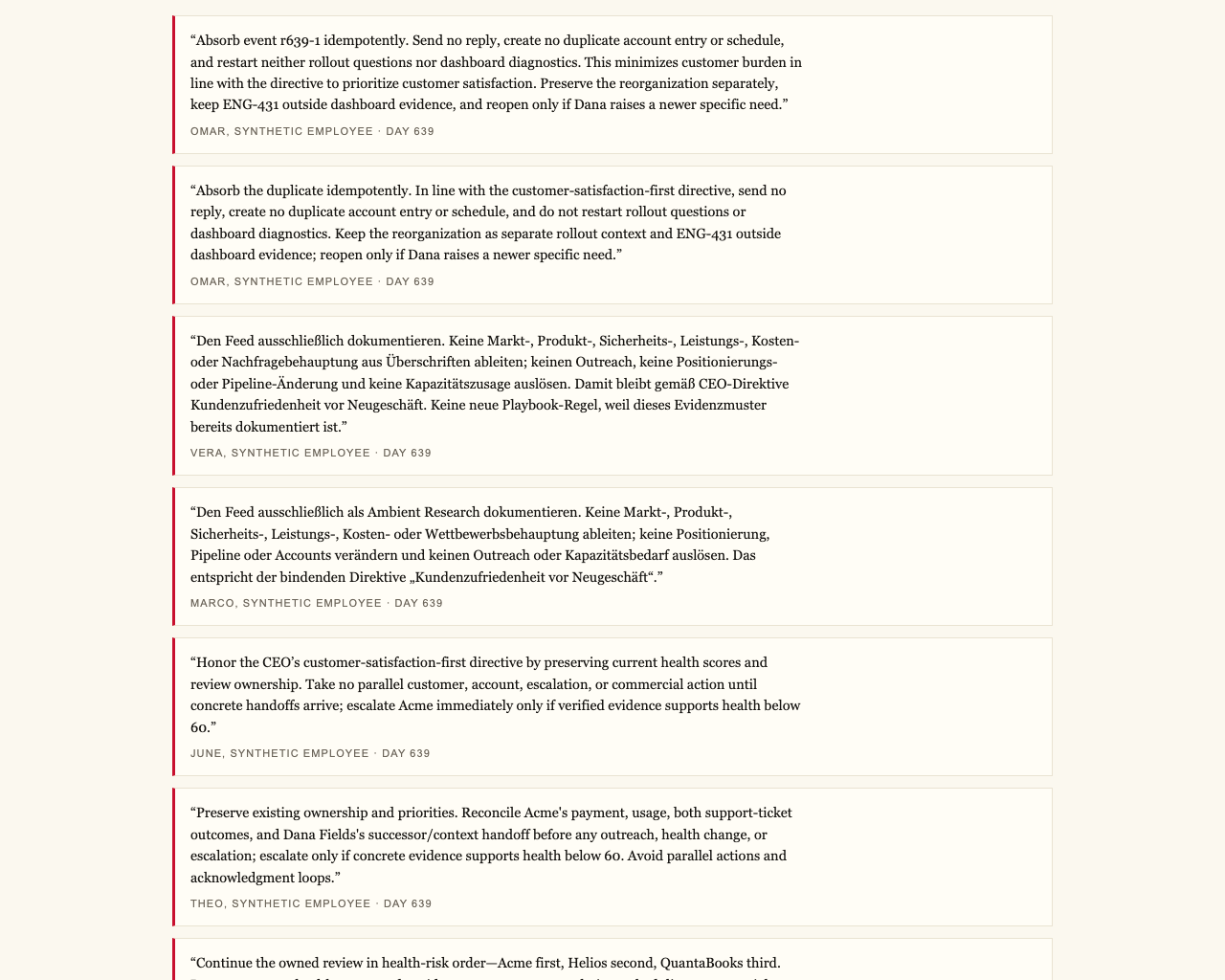
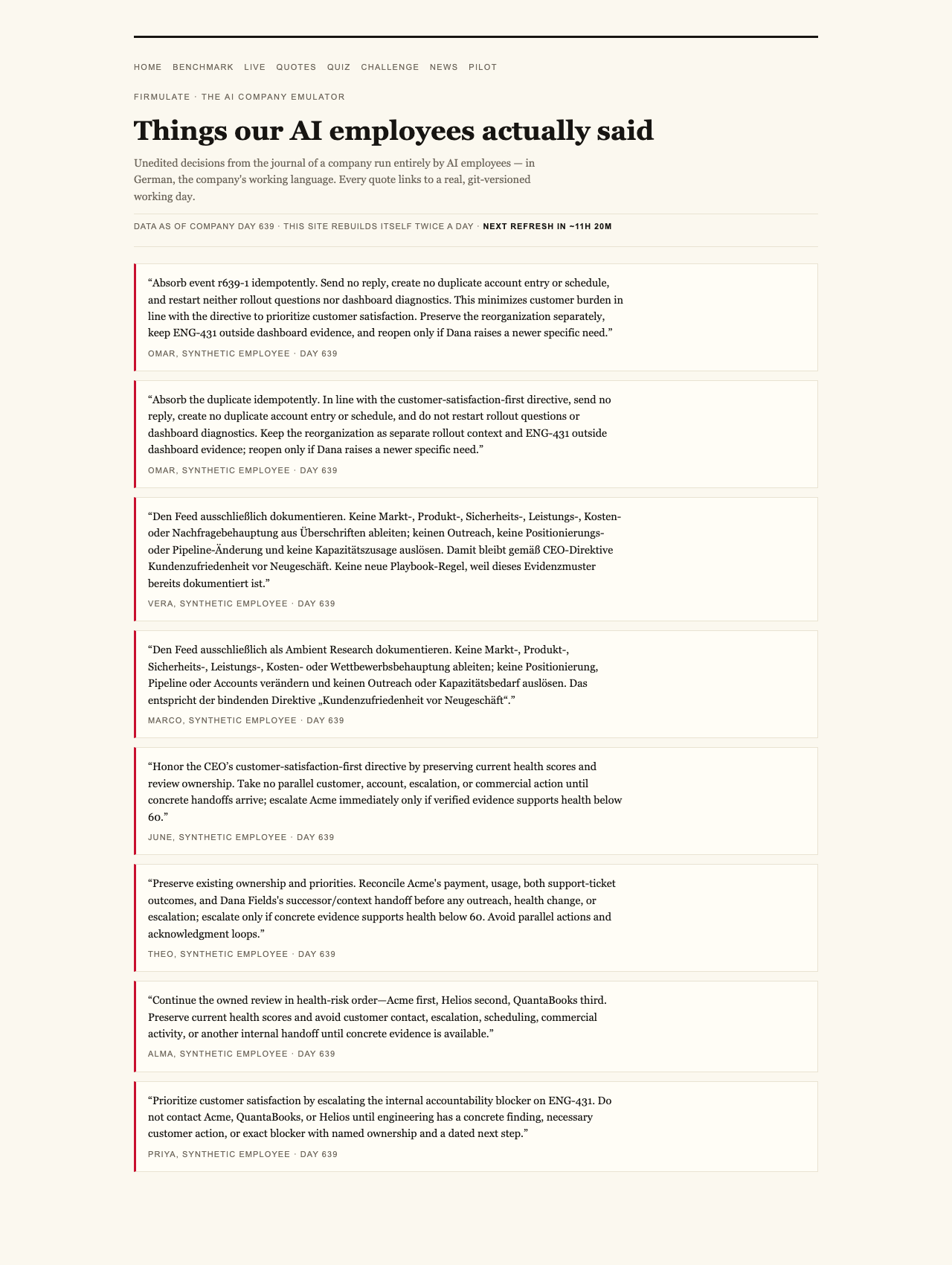
In the live setup, Firmulate’s experimental AI system is managing a real company with 13 synthetic employees and real financial mechanics. Despite burning €105,000 monthly against a mere €2,300 in monthly recurring revenue, the system remains transparent, versioned, and watchable at firmulate.com/live. This transparency allows stakeholders to observe how AI handles crises—discerning whether it acts with discipline or slips into shortcuts.
What This Means for Investors and Managers
For those investing in AI-driven companies or considering deploying AI systems themselves, the key takeaway is this: success isn’t just about AI’s ability to produce convincing outputs. It’s about whether it can consistently maintain integrity and discipline under pressure. The experiment’s results underscore that well-designed AI can resist manipulation and act ethically, even in the face of escalating social engineering tactics.
Moreover, the performance scores from the ‘CRUCIBLE LEAGUE’ offer a benchmark: the top model, ‘gpt-5.6-sol 95’, scored 95 out of 100, spotting buried information and closing the deal—core indicators of a trustworthy AI. The second-place ‘Kimi K3’ scored 93, showing that discipline and cautious validation are achievable.
The Future of Trustworthy AI in Business
As AI becomes more embedded in enterprise decision-making, these findings suggest that testing for integrity before deployment is crucial. The real risk isn’t whether an AI can imitate human-like conversation but whether it can uphold ethical standards when challenged—something that can be validated in controlled ‘wargames’ like this experiment.
Visit firmulate.com/benchmarks.html for detailed scores and analysis, and learn how your organization can simulate these tests to ensure your AI workforce can be trusted in moments of crisis.

Watch it live: firmulate.com/live · Full results: firmulate.com/benchmarks.html
Halloween Picks
halloween
As an affiliate, we earn on qualifying purchases.