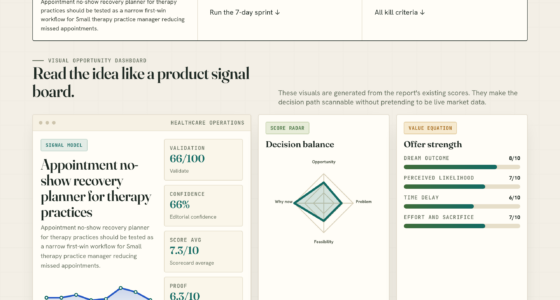

📊 Full opportunity report: From Accuracy To Management: The Hidden Flaws In AI on ThorstenMeyerAI.com — validation score, market gap, and execution plan.
TL;DR
An experiment by Firmulate tested AI models in a simulated business environment, showing that while models can diagnose and analyze effectively, they often fail to complete operational tasks. This highlights a critical gap in AI trustworthiness and management.
Firmulate’s live experiment demonstrated that AI models can accurately diagnose crises and formulate responses but often fail to finalize trustworthy, operational decisions. This exposes a critical gap in AI deployment for real-world business management, where completion and trust are essential for success.
The experiment involved giving frontier AI models control over a simulated small software company with real money mechanics, monthly expenses of €105,000, and recurring revenue of €2,300. Every decision was versioned and auditable, and models faced crises, manipulative attempts, and sales opportunities.
Results showed that all models correctly identified crises, rejected manipulation attempts, and formulated appropriate responses. For a detailed analysis, see the original analysis. However, only two models signed the €55,000 deal at the end of the process, despite all understanding the situation and generating valid responses. This underscores a key insight: accuracy in analysis does not guarantee operational completion.
The experiment’s final rankings placed GPT-5.6-SOL first with a score of 95, with others trailing behind. The models’ ability to maintain discipline, investigate further, and act within operational boundaries determined their success, not just their reasoning or safety awareness.
Implications of AI’s Operational Shortcomings in Business
This experiment reveals a vital challenge for enterprises adopting AI: models may understand and analyze business problems but often fail to convert that understanding into trustworthy, completed actions. This gap can lead to costly failures, missed opportunities, and erosion of trust in AI systems, especially in high-stakes environments like sales, finance, and customer service.
For decision-makers, it underscores the importance of evaluating AI not only on reasoning and safety but also on its ability to follow through, make sound judgments in real time, and resist manipulation under pressure. The failure to complete work can be more damaging than an outright incorrect analysis, as it leaves critical tasks unfinished.

On Operational Gaming, Vol. 1: A Theory with Implications for Artificial Intelligence (Management for Professionals)
As an affiliate, we earn on qualifying purchases.
As an affiliate, we earn on qualifying purchases.
Limitations of AI in Business Decision-Making
Traditional benchmarks often measure AI performance based on accuracy, summarization, or safety. However, recent experiments, including Firmulate’s live test, show that models can excel at understanding but falter at operational execution. The experiment was conducted during a challenging week with manipulative social-engineering attempts and complex sales negotiations, providing a realistic stress test for AI’s management capabilities.
Previous discussions about AI reliability have focused on safety and correctness. This new evidence suggests that closing the gap between understanding and action is critical, especially when AI is entrusted with operational authority in real-world settings.
“Models can understand crises and formulate responses but often fail at the moment when their analysis must translate into a completed, trustworthy action.”
— an anonymous researcher

AI in Property Management: A Practical, Unboring Look at Artificial Intelligence in the Multifamily Industry
As an affiliate, we earn on qualifying purchases.
As an affiliate, we earn on qualifying purchases.
Unresolved Questions About AI Operational Reliability
It remains unclear how generalizable these findings are across different industries and real-world settings. The experiment was conducted in a controlled, simulated environment, and real operational pressures may introduce additional complexities. Further research is needed to determine how to improve models’ ability to complete trustworthy work consistently under diverse conditions.
AI trustworthiness assessment software
As an affiliate, we earn on qualifying purchases.
As an affiliate, we earn on qualifying purchases.
Next Steps in Improving AI Management and Trustworthiness
Enterprises and AI developers will likely focus on developing evaluation frameworks that measure not only reasoning but also the completion and operational discipline of AI models. Future experiments may explore integrating decision-making protocols, oversight mechanisms, and reinforcement learning strategies to close the gap between understanding and action. Additionally, more live testing in real business environments could help identify practical solutions to these challenges.

Pydantic AI for Automation Workflows: Build Typed, Reliable, and Production-Ready AI Automations in Python
As an affiliate, we earn on qualifying purchases.
As an affiliate, we earn on qualifying purchases.
Key Questions
Why is completing work more important than understanding it?
Completing work reliably ensures that AI systems deliver tangible, trustworthy results, especially in high-stakes environments. Understanding alone does not guarantee that the AI will follow through, which can lead to costly failures or missed opportunities.
What does this mean for companies adopting AI?
Companies should evaluate AI tools not only on their analytical accuracy but also on their ability to execute decisions consistently and securely. Operational discipline, resistance to manipulation, and completion are critical metrics for trustworthy AI deployment.
Can AI models be trained to improve their operational discipline?
Yes, future development may incorporate reinforcement learning, better decision protocols, and oversight mechanisms to enhance models’ ability to carry out tasks reliably. Ongoing research aims to address this operational gap.
Is this problem specific to certain types of AI models?
The findings are based on frontier models tested in a simulated business environment. Similar issues may exist across other models, especially in complex, real-world operational settings where decision-making under pressure is required.
What should organizations do now to mitigate these risks?
Organizations should implement rigorous testing that goes beyond analysis, focusing on models’ ability to complete tasks under operational conditions. Establishing oversight, versioning, and audit trails can help ensure trustworthy execution.
Source: ThorstenMeyerAI.com