
TL;DR
Building your own AI workstation used to be cheaper, but recent component shortages and bulk buying have closed that gap. Choosing depends on your time, expertise, and need for support—it’s no longer just about saving money.
If you’re eyeing an AI workstation, the question isn’t just about price anymore. It’s about control, support, and getting the machine you need fast. The old rule — build cheaper, buy faster — no longer holds true. The market’s shifted, and now how you choose depends on your workload, skills, and support needs.
Whether you’re a hobbyist, a small team, or a professional lab, understanding the real tradeoffs will save you time, money, and frustration down the line.
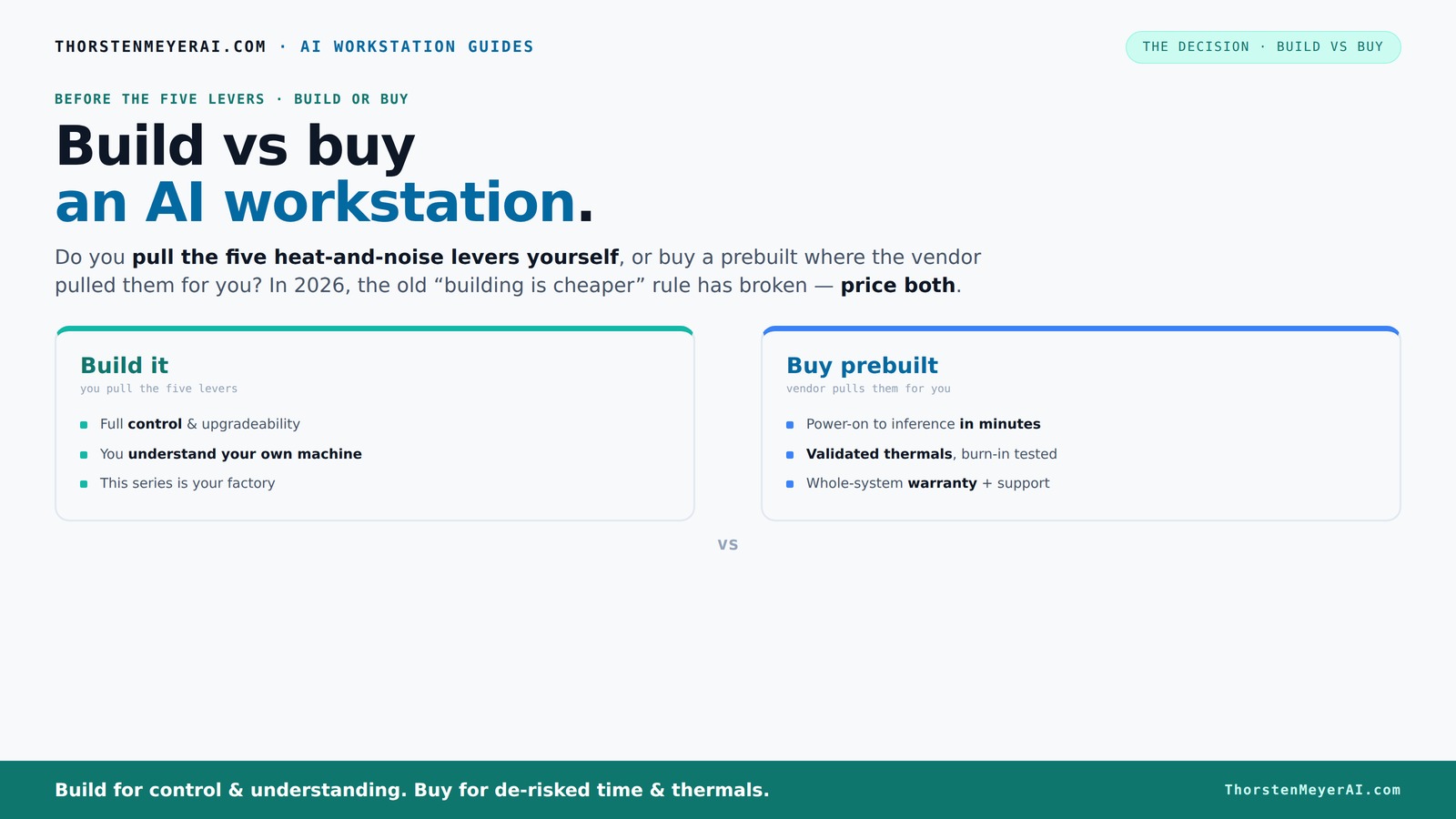
Build vs buy
an AI workstation.
The real question behind this whole series: do you pull the five heat-and-noise levers yourself, or buy a prebuilt where the vendor pulled them for you? And in 2026, the old “building is cheaper” rule has broken. Match your situation in Part 3.
Key Takeaways
- Component shortages in 2026 have made prebuilt AI workstations often comparable or cheaper than DIY builds, due to bulk buying and market pressures. Build vs Buy a Prebuilt AI Workstation
- Prebuilt systems save time, reduce risks, and come with validated thermals, warranties, and support — ideal for quick deployment and professional reliability.
- Building your own offers maximum control, customization, and upgradeability, but requires hardware expertise and time investment.
- When your workload demands multi-GPU setups or immediate productivity, prebuilt is usually the safer choice.
- Long-term, consider upgrade paths and resale value — building offers flexibility, but prebuilt can maintain value better if from reputable brands.

NVD RTX PRO 6000 Blackwell Professional Workstation Edition Graphics Card for AI, Design, Simulation, Engineering - 96GB DDR7 ECC Memory - 4th Gen RT/5th Gen Tensor Core GPU - OEM Packaging
[NVIDIA Blackwell Streaming Multiprocessor] The new SM features increased processing throughput, and new neural shaders that integrate neural...
As an affiliate, we earn on qualifying purchases.
As an affiliate, we earn on qualifying purchases.
Why the 'Build' Option Isn’t Always Cheaper Anymore
Building your own AI workstation used to be the clear winner on cost. That’s because you could cherry-pick parts, avoid markup, and have full control. But in 2026, the landscape changed. Component shortages have driven up prices for GPUs, RAM, and SSDs — often making DIY more expensive than buying prebuilt.
For example, a high-end GPU like the NVIDIA RTX 4090 now costs over $1,600, up from around $1,200 just two years ago. Meanwhile, prebuilt vendors buy in bulk, locking in lower prices. A BIZON or Lambda prebuilt system with similar specs might cost around $3,200 — sometimes less than sourcing parts and assembling yourself.
Beyond raw costs, it’s important to consider the implications of these market shifts. Component shortages mean longer wait times for parts, which can delay your project. Higher prices for individual components reduce the cost savings of DIY, especially if you factor in the time spent sourcing, troubleshooting, and assembling. Additionally, bulk purchasing by vendors often includes optimized configurations and testing, which can lead to better reliability and performance out of the box. The tradeoff here is that DIY might now require more upfront investment and patience, while prebuilt options offer immediate readiness and support. This shift forces a more nuanced decision: is your priority cost savings, or is it faster deployment and guaranteed stability?

Dell ECT1250 Tower Desktop Computer - Intel Core Ultra 5 225 Processor, 16GB DDR5 RAM, 512GB NVMe SSD, Intel UHD Graphics, Wi-Fi 6 & Bluetooth 5.4, Keyboard & Mouse, AI Copilot, Windows 11 Pro
Intel Core Ultra 5-225 10-Core 3.30 GHz Processor (20MB Intel Smart Cache, Turbo Boost up to 4.90 GHz),...
As an affiliate, we earn on qualifying purchases.
As an affiliate, we earn on qualifying purchases.
What Do You Get When You Buy a Prebuilt AI Workstation?
Prebuilt systems come with a lot of advantages. They arrive ready to run, with the OS, AI frameworks, and drivers installed. Build vs Buy a Prebuilt AI Workstation No sourcing parts, no BIOS tweaking, no hardware headaches. You power on, and you’re in business.
Plus, these vendors rigorously test thermals and stability. Many offer warranties of 3 to 5 years, covering parts and labor. If something goes wrong, support is just a phone call away.
But why does this matter? The pre-configuration and testing process means you get a system optimized for AI workloads, with thermal management and stability tested under real-world conditions. This reduces the risk of thermal throttling or hardware failures during intensive tasks, which can be costly in downtime and troubleshooting. The support and warranty are not just safety nets; they are crucial for professional environments where downtime can translate into significant financial loss. Moreover, vendor validation of multi-GPU setups ensures that your system is designed for high-performance AI tasks, minimizing the guesswork and trial-and-error that often accompany DIY configurations. So, investing in a prebuilt is not just about convenience; it’s about reliability, peace of mind, and ensuring consistent performance for demanding AI workloads.

ME2 Customized Lenovo ThinkPad P14s Gen 6 Copilot+ Mobile Workstation
Professional Upgrade Notice – The original seal was carefully opened to perform certified RAM/SSD upgrades. The upgraded RAM/SSD...
As an affiliate, we earn on qualifying purchases.
As an affiliate, we earn on qualifying purchases.
What Does Building Your Own AI Workstation Entail?
Building your own rig means choosing every component, from the GPU to the power supply. Build vs Buy a Prebuilt AI Workstation You pick a quiet GPU like the RTX 4080, undervolt it for less heat, select a cooling system, and fine-tune airflow. It’s all about customization.
Imagine spending a weekend assembling a machine with a custom case, low-noise fans, and a water cooler. When done right, you get a machine perfectly tuned for your workload — whether it’s inference or training. Plus, you learn how each part works, so future upgrades are easier.
But it’s not just fun and games. Troubleshooting driver issues or thermal bottlenecks falls on you. If you’re comfortable with hardware and software, the control can be worth the effort. The tradeoff is that this process requires a good understanding of hardware compatibility, thermal dynamics, and BIOS configuration. Mistakes or overlooked details can cause system instability or thermal throttling, which hampers performance and can damage components over time. However, the benefits include tailored performance, cost savings when upgrading selectively, and the satisfaction of mastery over your hardware environment. For those willing to invest the time and effort, building your own system offers a level of control and customization that prebuilt options cannot match, but this comes with increased responsibility and potential troubleshooting challenges.

NOVATECH AI Workstation Desktop PC – Intel Core i9-14900K, Liquid Cooling – Machine Learning, Data Science, 3D Rendering, Video Editing, Simulation (RTX PRO 6000 | 192GB RAM | 10TB)
Extreme AI & Machine Learning Performance Powered by the Intel Core i9-14900K and RTX PRO 6000 with 96GB...
As an affiliate, we earn on qualifying purchases.
As an affiliate, we earn on qualifying purchases.
Comparison Table: Build vs Buy — What’s the Real Difference?
| Feature | Build Your Own | Buy Prebuilt |
|---|---|---|
| Cost (initial) | Lower on parts, but hidden costs for time and troubleshooting | Often similar or slightly higher, but includes assembly, testing, warranty |
| Time to deploy | Days to weeks, depending on sourcing and assembly | Ready to run in hours, sometimes minutes |
| Support & Warranty | Limited or DIY support, no warranty | Full support, typically 3-5 years warranty |
| Customization | Complete, from cooling to hardware choices | Limited to vendor options, but often customizable within limits |
| Upgradeability | High — easy to swap parts, add GPUs | Depends on model, often limited but some support upgrades |
| Thermal control | You tune it yourself, based on experience | Factory-validated, optimized cooling and noise levels |
When Should You Opt for a Prebuilt System?
If speed, support, and reliability matter most, prebuilt is the way to go. For example, a small AI startup might need to start training models next week. Buying a prebuilt means no sourcing delays, no assembly errors, and immediate support if something goes wrong.
Additionally, multi-GPU setups, which are notoriously tricky to configure and cool, benefit from vendor validation. Lambda, for example, tests multi-GPU systems extensively, minimizing your risk of bottlenecks or thermal throttling.
And if your team isn’t hardware-savvy, the support and warranty can save serious headaches — especially with complex AI workloads that demand stability.
When Is Building Your Own AI Workstation the Better Move?
If you have the time, skills, and a specific workload, building can be rewarding. For instance, a researcher might want to optimize cooling for long training runs or customize the hardware for particular AI frameworks. It’s about control and cost savings in the long run.
For hobbyists or students, building often costs less on parts alone, especially if you reuse components or upgrade gradually. Plus, the hands-on experience makes troubleshooting easier and prepares you for future projects.
However, remember that this path requires a good grasp of hardware, BIOS tuning, and thermal management. Without that, you risk thermal issues or instability. The key implication is that building is best suited for those who value deep customization and learning, but it demands a significant investment of time and expertise. Missteps can lead to suboptimal performance or hardware failures, which can be costly and frustrating. Conversely, it offers the chance to create a system precisely aligned with your needs, with potential long-term savings and educational benefits.
Should You Consider Cloud or Hybrid Solutions?
Cloud GPU services like AWS or Azure are tempting for occasional workloads or testing. However, for high-utilization tasks, owning your hardware can cut long-term costs and reduce latency. According to recent data, local ownership can be more cost-effective over 1-3 years if you run daily training jobs.
Plus, on-premise systems offer privacy and control that cloud setups can’t match. But cloud remains a flexible option for burst workloads or experiments.
The main tradeoff is that cloud solutions offer scalability and ease of use, but at the expense of ongoing costs and potential data security concerns. Owning a local workstation involves higher upfront investment but can lead to significant savings if you run continuous, intensive workloads. Also, latency-sensitive applications benefit from local hardware, as data transfer times are minimized. The decision hinges on workload predictability, security requirements, and budget constraints, making it essential to analyze your specific use case.
Upgrade Paths and Resale Value — What’s the Long Game?
Building your own machine offers the best upgrade flexibility. You can add more GPUs, upgrade RAM, or swap out cooling. It’s like adding new tools to your workshop over time. This flexibility means you can adapt your system as your workload grows or changes, potentially extending its useful lifespan. However, resale value depends heavily on the age and demand for individual components, which can depreciate quickly, especially with rapid hardware advancements.
Prebuilt systems often have limited upgrade paths, but they tend to hold their value better if they’re from reputable brands because of consistent quality and brand recognition. Some vendors even buy back old systems, which can offset the initial purchase cost and make upgrading more financially feasible. The long game involves weighing the ease of future upgrades against the potential resale value; building offers more control but may depreciate faster, while prebuilt systems might retain value better but with less upgrade flexibility.
Your Checklist for Choosing the Right Approach
- Assess your workload: inference, training, multi-GPU needs?
- Consider your skill level: comfortable with hardware and thermal tuning?
- Calculate total cost over 1-3 years, including support and downtime risks.
- Evaluate how quickly you need to deploy — can you wait for a custom build?
- Think about upgrade plans: future-proof or plug-and-play?
- Research vendors and component options — check reviews and support policies.
Frequently Asked Questions
Is it cheaper to build or buy an AI workstation?
It depends. Recent market shortages have driven up component prices, making prebuilt systems often cost-competitive or even cheaper than DIY. You need to compare specific configurations and consider the value of your time and expertise.
What AI tasks justify a prebuilt workstation instead of cloud GPUs?
If you run high-utilization workloads, multi-GPU setups, or need guaranteed stability and support, owning your own hardware makes sense. Cloud is better for occasional testing or burst workloads.
How much GPU VRAM do I need for training versus inference?
For training large models, 48-80GB VRAM per GPU is common; for inference, 8-16GB often suffices. Your choice hinges on model size and batch processing needs — check your specific workload to decide.
Can I upgrade a prebuilt AI workstation later?
It depends on the model. Some vendors design for upgrades, allowing additional GPUs or RAM, while others are more fixed. Always review upgrade policies and compatibility before buying.
Are prebuilt workstations reliable enough for professional AI use?
Yes, if you buy from reputable vendors like Lambda or Puget, they rigorously test their systems and offer support warranties. This reduces risk compared to DIY, especially under sustained workloads.
Conclusion
In 2026, choosing between build and buy isn’t just about saving money—it's about aligning your workload, skills, and support needs. If speed and reliability matter, a prebuilt system can get you running faster with less hassle. But if you crave control and customization, building your own can still pay off — if you’re prepared for the effort.
Remember, the right choice depends on your specific needs, not just the price tag. Whether you assemble or acquire, focus on what will keep your AI projects humming smoothly — because in this game, efficiency and stability are everything.